

Your five-year-old can keep the nation safe

Kindergartner Allyson Zavala joined with other students and school superintendent Austin Buetner for a class selfie in April inside teacher Alicia Pizzi'southward classroom at Maurice Sendak Elementary School in North Hollywood, Calif. Robert Gauthier/Los Angeles Times via Getty Images hibernate explanation
toggle caption
Robert Gauthier/Los Angeles Times via Getty Images
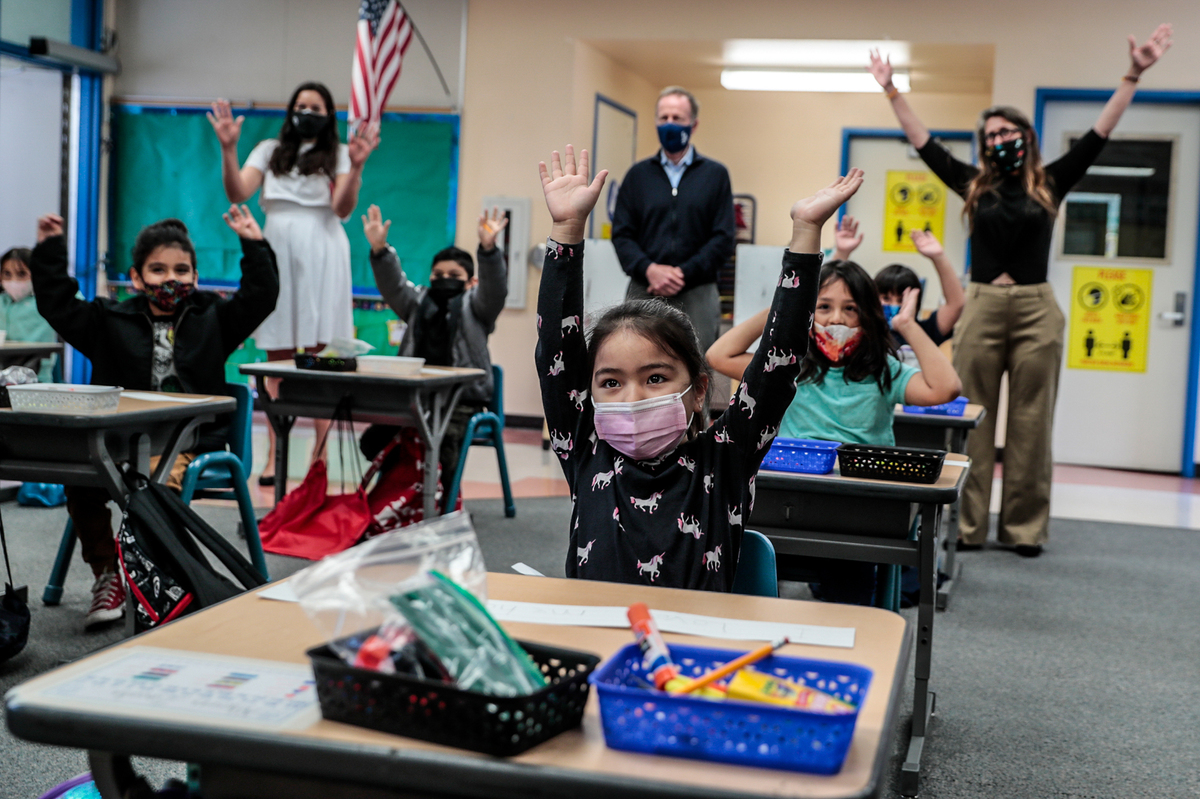
Kindergartner Allyson Zavala joined with other students and school superintendent Austin Buetner for a class selfie in Apr inside teacher Alicia Pizzi's classroom at Maurice Sendak Simple School in North Hollywood, Calif.
Robert Gauthier/Los Angeles Times via Getty Images
Information technology's inevitable that when kids mix — returning from camp or heading back to school — germs spread. And in a pandemic year fueled by the delta variant, some of those germs may cause COVID-nineteen. The Centers for Disease Control and Prevention has communication for keeping your kid protected from this highly contagious version of the coronavirus now and this fall: Mask upward in schools and other crowded venues, and make sure everyone age 12 and older in the family gets a COVID-19 shot.
But what if your kids are younger than that? What if they develop symptoms or come up into contact with someone who tests positive for the coronavirus?
Rules for testing and quarantining vary from place to place, so we asked several public health experts — all parents — about their personal strategies for keeping their kids and families safe these days.
What do I do if my kid wakes up with the sniffles?
Keep your kid at home and consult the pediatrician.
"This happened to us [recently], for camp," says Seema Lakdawala, a virologist who studies influenza manual at the University of Pittsburgh. She has 2 daughters, ages five and viii. "My [eight-year-old] daughter woke upwardly and was sneezing and had a runny nose."
She kept her daughter habitation and and so called the pediatrician to talk through her symptoms. The probable culprit was allergies, the doctor told her; the child has known allergies to grass pollen, and information technology's already hay fever flavor where she lives. Certain enough, when Lakdawala gave her daughter allergy medication, her symptoms resolved.
The cardinal, says Lakdawala, is that her girl had no known exposures to COVID-19. "If we had been on a plane recently, or otherwise traveling, then I would definitely want to become her tested for COVID," the mom says.
Exam for the coronavirus when warranted.
Alee of those sniffles, while anybody'south healthy, figure out where your kid and others in your home can get PCR-tested for the coronavirus on brusque observe with quick results. "Our pediatrician's office, like many pediatric clinics, has walk-in hours for children who are sick," says Dr. Cassandra Pierre, medical managing director of public health programs at Boston Medical Center and a parent of 3-twelvemonth-old twins. "Those hours are in the morning time, which means my child could become tested and, hopefully, become the results in the same solar day."
Keep your child at domicile until those test results come dorsum.
Another choice is to buy some over-the-counter, rapid antigen tests from the pharmacy now and keep them in your medicine cabinet for a time when you might need them, says Gigi Gronvall, an immunologist and researcher at the Johns Hopkins Middle for Health Security. She has two kids, ages 11 and xiv. These swab tests are less sensitive than PCR tests (and so they might miss very small-scale infections). But they're quick, easy to use, and considered to exist fairly authentic in people who are actively ill. "They certainly provide peace of mind, especially if they're symptomatic," Gronvall says.
Even if those symptoms plow out to be "just a common cold," try non to spread it.
Whatsoever your child's COVID-19 status, please don't ship them back to school if they're still cough and sneezing, Pierre says.
Her iii-year-old was home ill from mean solar day care with a common cold the day we spoke with her. "If my son is still sick tomorrow, still stuffy and having nasal secretions, I wouldn't necessarily put him right back and expose other children to another respiratory virus," Pierre says. As difficult equally information technology is to arrange for kid care, the pandemic has driven home to her that "we really rely on the decisions that other people brand," she says. "I want to make sure that I'thou making adept decisions to prevent other children and parents potentially from getting ill."
If kids must render to camp or schoolhouse or day intendance with balmy common cold symptoms, they should wear masks consistently, says Dr. Monica Gandhi, an communicable diseases doctor at the University of California, San Francisco.
What if my child tests positive for the coronavirus?
"Don't panic," says Pierre. "The first thing to remember is that children are incredibly resilient." Most cases of COVID-xix in children are mild. Keep a shut heart on your child and check in with the pediatrician, particularly if your child has underlying health conditions that may need monitoring.
Recollect alee of time virtually who will take intendance of whom — and how — if somebody gets ill.
Households are complicated, but think right now about how y'all could limit the sick kid'southward contact with others in your abode. Consider how you lot and other members could best divvy up care. Lakdawala and her hubby have walked through this scenario. They are both fully vaccinated, just their ii children are not even so eligible. If one child tests positive for the coronavirus, she says, they will split the household into parent-child pairs in different parts of the firm. They might and so take turns in the kitchen and minimize the amount of time they're in enclosed spaces with each other.
If your state of affairs requires more backup, Lakdawala suggests reaching out to fully vaccinated family unit members, friends or neighbors who may exist able to step in and offering help.
Layer protections to reduce the chance of household manual
The key is to rely on multiple types of protection.
The first defense is vaccines, Pierre says. "Nosotros really should be thinking about getting every bit many people in the household vaccinated as possible to protect themselves, just also to protect the kid." Vaccinated people tin provide care without needing to quarantine, so long as they remain good for you, without COVID-19 symptoms.
An older kid who is sick with COVID-19 may exist able to isolate in a bedroom, maybe with a bath to themselves, says Pierre. This limits the presence of the virus to a specific part of the habitation.
Only even if space and bathrooms are limited, there are proven ways to reduce the risks of transmission.
COVID-19 is primarily transmitted through the air, then Pierre notes that "respiratory hygiene is your No. 1 priority."
If indoor space is shared with a sick person, everyone in the house should wear masks every bit much every bit possible, says Gandhi. This means at all times, except when eating, drinking and sleeping. For the sick person, this reduces the amount of virus they exhale into the air, and for others in the household, it limits the amount of virus they exhale in.
Get fresh air into the business firm to disperse any clouds of virus that may be lingering in the air, Lakdawala advises: "Open up the windows, plough on the fans, get some air circulating." Air purifiers could help filter virus out of the air in a airtight room, Pierre adds.
Another possible road of transmission is picking up the live virus on your easily and touching your eyes, olfactory organ or oral cavity. So periodically clean and disinfect shared surfaces such as the bathroom counter or kitchen table, specially if a sick person has been cough or sneezing nearby, Pierre says. Afterward a few days (the CDC recommends iii-5 days after a known exposure), it'due south a expert idea to get the rest of the household tested for the coronavirus.
Keep your child home until they're no longer contagious.
Though asymptomatic infections can spread disease, too, people with COVID-19 are well-nigh likely to spread the infection to others when symptoms commencement appear. So 10 days after, if those symptoms have resolved without the connected use of fever-reducing medicine, the illness is no longer considered contagious, Gronvall says. Sometimes, children develop symptoms such as loss of taste and smell that tin can last longer, "but as far as at that place beingness a danger to others, these symptoms don't need to interfere with them going back to school," she says.
What kind of mask should a kid wear?
Clothing whatsoever mask that fits well — with no gaps around the mouth, nose or chin — and is comfortable. While adults these days are being encouraged to step up our mask game beyond material versions, the communication for children may be a little unlike. "The best mask is one that they can wear for long periods of time, even in school," Pierre says. "A cotton mask is the most comfortable, lightweight and breathable."
Bonus points if the kids like the design. "My kids have the cutest masks," Lakdawala says. "They have the ones that expect like little cat faces and smiley faces or dogs or bears or whatsoever." Gronvall's xi-yr-sometime prefers a mask that is "silky and has pictures of cats in outer space that accept lasers coming out of their eyes," so she has ordered several of those masks to ship with him to schoolhouse. A child is more probable to clothing a mask they find highly-seasoned, and to wear it consistently and correctly.
If you want to add together more protection, Gandhi suggests wearing two masks, which creates a tighter mask fit on the face, or adding a filter layer to a child's mask. "Yous tin can buy a textile mask with a pocket, and use vacuum handbag fabric equally a filter. It's thin and it blocks virus very effectively," she says. Still, she agrees that the bottom line with kids is condolement. And then if these interventions brand them less likely to clothing the mask, she says you lot can skip them.
Is it OK to hug our kids when they're sick with COVID-xix?
The reassurance of physical contact — hugs and cuddles — can be important, specially for footling ones, Lakdawala says. "I'm not going to deny or deprive my child of that comfort when they're non feeling well." And you may feel that way, besides. Just Pierre says that if the kids are older, "I would recommend physical distancing."
Studies suggest that a person with COVID-19 is most infectious in the first v days, so Gandhi says she'd aim to limit close contact in that period. "For the starting time five days, I'd let them picket Tv and I would attempt to not be equally cuddly," she says.
"At dark, if a child has a fever and needs comfort, that can exist difficult," says Pierre. Nobody recommends wearing a protective mask while sleeping, but if you're sharing a bed with a sick kid, you lot might consider facing in the same direction from behind them, or away — and then they're not breathing directly into your face up — and opening upwardly the windows or using air purifiers to assist articulate the air.
Lakdawala says wearing masks when someone is sick with COVID-19, and, again, divvying up care responsibilities betwixt the parents (including hugs), can help reduce the chance that everyone in the household gets sick.
What do I do if my child is sent dwelling house from school afterward a COVID-19 exposure?
If your child is unvaccinated, quarantine your kid, wear masks, watch for symptoms and examination.
If the school district provides specific instructions for quarantining, follow that guidance, Pierre says. The CDC has a specific definition for "close contact" betwixt kids in schools, and it is more than lenient than in other settings: "If your child is physically distancing 3 anxiety from another child who's sick and both of them are wearing masks consistently, we would not really consider that to be an exposure," says Pierre. "But if that is not what has happened, and then the child needs to be quarantined."
In the house, take reasonable precautions, says Pierre, "but it'due south not necessarily with the rigor of having to become to your room and stay there," unless your kid develops symptoms or tests positive for the coronavirus. Instead, try to proceed some physical altitude between the quarantining child and other household members, and have the child and/or those other family members vesture a mask, especially those who are the most vulnerable and unvaccinated.
In Lakdawala's home, her two children — both also young to be vaccinated — typically share a room. If ane were in quarantine, "I would carve up them in terms of where they would sleep, only I would probably notwithstanding ship the other i to school if information technology was just an exposure," she says.
She would await a few days and and then go the quarantining child tested for the coronavirus with a PCR test. In the acting, she'd watch for symptoms. If no symptoms develop or the test comes dorsum negative, it'due south fine to resume all the usual activities after 7 to 14 days, depending on your school'due south policy.
And while the child in quarantine is staying dwelling, Lakdawala says, the rest of the household can keep on with essential business — school, work, grocery shopping and the like — with some precautions. The whole family unit should refrain from playdates or dinners out and clothing masks in public, indoor settings.
NPR editor and producer Jane Greenhalgh and contributor Rob Stein contributed reporting to this story.
Source: https://www.npr.org/sections/health-shots/2021/08/10/1025663559/how-to-keep-your-child-safe-from-the-delta-variant
Posted by: nationsanney1981.blogspot.com
0 Response to "Your five-year-old can keep the nation safe"
Post a Comment