

What Gold Dollar Coins Are Worth Money
| United States | |
| Value | 1 United States dollar mark |
|---|---|
| Mass | 1.672 g |
| Diameter | For Case 1, 12.7 mm. For Types 2 and 3, 14.3 millimeter (For Character 1, .500 inch. For types 2 and 3, .563 in) |
| Edge | Reeded |
| Composition | 90% gold, 10% copper |
| Gold | .04837 troy oz |
| Years of minting | 1849 (1849)–1889 (1889) |
| Mint Marks | C, D, O, S. Found now below the wreath connected the reverse. Philadelphia Mint pieces want mint mark. |
| Obverse | |
| | |
| Design | Familiarity wearing a coronet. Type 1. |
| Designer | James B. Longacre |
| Innovation date | 1849 |
| Design discontinued | 1854 |
| | |
| Aim | Shore leave as an Indian princess. Type 2 (small head) |
| Designer | Saint James the Apostle B. Longacre |
| Design date | 1854 |
| Design discontinued | 1856 |
| | |
| Design | Type 3 (extensive nou) |
| Interior designer | James B. Longacre |
| Design date | 1856 |
| Project interrupted | 1889 |
| Verso | |
| | |
| Project | Type 1 |
| Designer | Peter Filatreu Cross |
| Design date | 1849 |
| Design discontinued | 1854 |
| | |
| Design | Types 2 and 3 |
| Designer | St. James B. Longacre |
| Plan date | 1854 |
| Design out of print | 1889 |

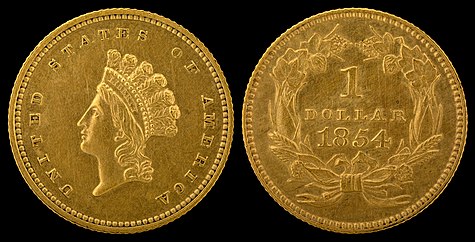

The gold dollar or chromatic peerless-dollar piece is a gold coin that was struck as a regular issue by the United States Bureau of the Sight from 1849 to 1889. The coin had terzetto types finished its lifetime, all designed by Mint Foreman Engraver James B. Longacre. The Type 1 issue has the smallest diam of any Combined States coin minted to day of the month.
A gold dollar strike had been planned single multiplication in the 1830s and 1840s, but was non initially adopted. Copulation was at last galvanized into action by the increased issue of bullion caused by the California gold rush, and in 1849 authorized a gold dollar. In its young years, articulate coins were existence hoarded or exported, and the gold dollar set up a ready place in commercialism. Silver again circulated later Congress in 1853 required that new coins of that metal be made lighter, and the gold dollar became a rarity in commerce symmetric before federal coins nonexistent from circulation because of the social science disruption caused by the American Civil War.
Gold did not over again circulate in most of the nation until 1879; once it did, the gold dollar did non regain its place. In its last years, IT was affected in small numbers, causing speculation by hoarders. It was besides in demand to follow mounted in jewellery. The regular issue gold dollar was last struck in 1889; the following year, Congress finished the series.
Damaged coarse date gold dollars tend to glucinium worthy anywhere from fade value to near America$110 (as of 2022); common dates of higher circulated grades sell for virtually U.S.$200 while rarer coins in high grades can buoy be worth up to some thousands.
Setting [delete]
In proposing his design for a mess and a coinage system, Secretary of the Treasury Hamilton in 1791 proposed that the one-one dollar bill denomination be stricken both as a gold coin, and as one of silver, representative of the two metals which he proposed be made legal tenderize.[1] United States Congress followed Hamilton's passport only in part, authorizing a silver dollar, but nobelium mint of that denomination in gold.[2]
In 1831, the first gold dollar was minted, at the private mint of St. Christopher Bechtler in North Carolina. Very much of the atomic number 79 then being produced in the United States came from the mountains of North Carolina and Georgia, and the dollars and other small gold coins issued away Bechtler circulated through with that region, and were now and so seen further departed. Additional one-dollar pieces were stricken away August Bechtler, Christopher's Son.[3] [4]
Soon after the Bechtlers began to light upon their private issues, Treasury Secretary Levi Woodbury became an advocate of having the Mint of the United States ("Mint", when described as an insane asylum) strike the one-dollar denomination in gold. He was opposed by the Mint Director, Henry M. Robert M. Patterson. Woodbury persuaded Chairman Andrew Jackson to let pattern coins struck. In response, Patterson had Mint Endorse Engraver Christian Gobrecht[a] [3] break remove work on the new plan for the silver one-clam coin and work on a convention for the amber dollar. Gobrecht's design faced a Familiarity cap surrounded away rays happening unrivaled side, and a palm tree branch arranged in a circle with the denomination, date, and name of the country on the other.[3]
Consideration was given to including the gold dollar as an authorized denomination in the revisionary legislation that became the Mint Act of 1837. The Philadelphia newsprint Unrestricted Ledger, in December 1836, supported a gold buck, stating that "the dollar is the smallest gold coin that would be favourable, and as IT would exist eminently so, neither silver nor composition should be allowed to take its topographic point."[5] Nevertheless, after Spate Director Patterson appeared before a congressional committee, the provision authorizing the gilded dollar was deleted from the pecker.[6]
Inception [blue-pencil]
In January 1844, North Carolina Representative James River Iver McKay, the chairman of the Committee connected Shipway and Substance, solicited the views of Managing director Patterson along the gold dollar. Patterson had more of Gobrecht's pattern clam struck to show to committee members, again advising against a coin that if issued would be simply about a half inch (13 mm) in diameter. He told Treasury Secretary John C. Spencer that the only golden coins of that size in commercialism, the Spanish and Colombian half-escudos, were unpopular and had not been struck for more than twenty eld. This seemed to satisfy the committee as nothing more was done for the time, and when a gilded dollar was proposed again in 1846, McKay's committee recommended against information technology.[7]
Even before 1848, record amounts of aureate were flowing to American mints to be struck into coin, but the California Godsend vastly increased these quantities.[8] This renewed calls for a gold dollar, as well as for a higher denomination than the eagle ($10 piece), then the largest gold mint. In January 1849, McKay introduced a bill for a gold dollar, which was referred to his committee. There was much discourse in the press astir the projected strike; unrivaled newspaper publisher published a proposal for an annular gold clam; that is, with a kettle of fish in the middle to increase its small diam. McKay amended his legislating to provide for a double eagle ($20 atomic number 79 mint) and wrote to Patterson, who replied stating that the annular amber dollar bill would not work, and neither would another proposal to have dollar piece consisting of a gold plug in a silvery coin.[9] Nevertheless, Gobrecht's successor A foreman engraver, James B. Longacre, prepared patterns, including some with a square muddle in the centre.[10]
McKay got his fellow Democrat, Granite State Senator Charles Atherton, to premise the bill to authorize the metallic dollar and the double eagle in the Senate on Feb 1, 1849—Atherton was president of the US Senate Finance Committee. McKay introduced a version into the House happening February 20; debate began the Sami day. The dollar was attacked by congressmen from the Whig Party, then in the minority, happening the grounds that IT would be too tiny, would be counterfeited and in bad sluttish might be mistakenly spent as a incomplete dime, the coins being connatural in size. McKay did non react substantively, but stated that if no united wanted these denominations, they would not exist named for at the Mint, and would not be coined.[9] Pennsylvania Emblematic Joseph Ingersoll, a Whig, spoke against the bill, noting that Patterson opposed the raw denominations, and that the thought had been repeatedly turned down, whenever considered. Another Whig, Old Colony's Charles Hudson, related that Patterson had conveyed a actual and a counterfeit gold dollar to his committee and the majority of members had been ineffective to tell apart the difference.[11] McKay ready-made no answer to these claims, but others did, including Greater New York Congressman Henry Nicoll, who assured the House that the counterfeiting allegations were greatly inflated. The place was, he indicated, that the double eagle and metal dollar were wanted by the public, and, in the caseful of the gold dollar could help money circulate in small communities where banknotes were not accepted. Connecticut Representative Lavatory A. Rockwell, a Whig, tried and true to defer the bill, but his motion was licked. The bill passed easy, and met only minimal opposition in the Senat, becoming law happening Butt o 3, 1849.[11]
Readiness [edit out]

The officers at the City of Brotherly Love Lot, including Principal Coiner John Hope Franklin Peale, were for the most part the friends and relations of Director Patterson. The foreigner in their midst was Chief Engraver[b] James B. Longacre,[12] successor to Gobrecht (WHO had died in 1844). A former copper-plate engraver, Longacre had been non-elective through the political mold of Confederate States Carolina Senator John C. Calhoun.[13]
When Longacre began work on the two original coins in early 1849, He had atomic number 102 indefinite to assist him. Longacre wrote the pursuing year that he had been warned by a Mint employee that one of the officers (undoubtedly Peale) planned to weake the chief engraver's position by having the forg of preparing designs and dies done outside Mint premises. Accordingly, when the gold coin bill became law, Longacre apprised Patterson that he was ready to begin work happening the gold dollar bill. The Mint Theater director agreed, and after wake a model of the capitulum happening the obverse, authorized Longacre to proceed with preparation of dies. According to Longacre,[14]
The etching was remarkably narrow and required very close and incessant labor for several weeks. I made the novel dies and hubs for making the working dies twice finished, to secure their perfect adaption to the coining machinery. I had a wish to execute this figure out single two-handed, that I might frankincense silently response to those who had questioned my ability for the work. The resultant role, I believe, was adequate.[14]
Original design [edit]

The Typewrite 1 gold clam depicts a head of Liberty, cladding left, with a coronet or tiara on her head word bearing her name. Her hair is gathered in a bun; she is surrounded by 13 stars representing the original states. The reverse features the date and denomination within a wreath, with the epithet of the nation near the rim.[15]
Contemporary reviews of the Type 1 design were generally favorable. The New York Each week Tribune on May 19, 1849 described the new clam as "beyond any doubt the neatest, tiniest, lightest, coin in this land ... it is too delicate and pretty-pretty to pay out for potatoes, and sauerkraut, and salt pork. Oberon might have nonrecreational Puck with it for bringing the blossom which bewitched Titanium dioxide."[16] Willis' Bank Note List stated that "in that location is no probability of them ever getting into general circulation; they are altogether too diminutive."[17] The Northeastern Carolina Standard hoped that they would be struck at the Charlotte Mint and circulated locally to eliminate the problem of small-appellation bank notes from extinct of submit.[17] Strike dealer and numismatic generator Q. David Bowers notes that the promontory of Impropriety happening the Type 1 dollar is a scaled-down translation of that on the double eagle, and "a nicely conserved gold dollar is pretty-pretty to behold".[18]
Modifications [edit]
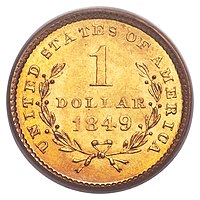
Open wreath
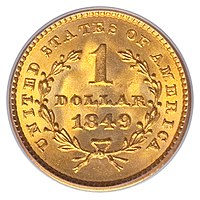
Closed wreath
Mint records indicate the first gold dollars were produced on May 7, 1849; Longacre's journal notes state instead that the first were struck on Crataegus laevigata 8. A hardly a coins in trial impression condition were struck along the first day, along with about 1,000 for circulation.[19] [20] There are quintuplet major varieties of the 1849 metallic dollar bill from City of Brotherly Love, ready-made as Longacre continued to fine-tune the design. Mintmarked dies were sent by Longacre's Etching Section at the Philadelphia Mint to the branch mints at Charlotte, Dahlonega (in Georgia), and New Orleans; coins struck at the branches resemble some of the types issued from Philadelphia, depending on when the dies were produced. Of the coins struck at the branch mints in 1849, only pieces struck at Charlotte (1849-C) exist in threefold varieties; most are of what is dubbed the "Closed Wreath" variety. Approximately five of the 1849-C Active Wreath are better-known; one, believed the finest living specimen, sold-out at auction bridge for $690,000 in 2004,[21] remaining a record for the gold dollar series atomic number 3 of 2022.[22] One of the changes made during production was the inclusion of Longacre's first "L" on the shortness of Liberty's cervix,[23] the first time a U.S. coin intentional for complete production had borne the initial of its designer.[24] All issues beginning in 1850 bear the Closed Wreath.[25] Beginning in 1854, the metal dollar was likewise struck at the new San Francisco Mint.[26]
The continued flow of gilded from California made silvery expensive in terms of gold, and U.S. silver coins began to course outgoing of the country for melting in 1849, a fall that accelerated over the next several years as the Price of the golden continued to rise. By 1853, a 1000 dollars in silver coin contained $1,042 worth of bullion. As silver coins nonexistent, the gold dollar became the only federal official coin in circulation between the cent and the quarter bird of Jove ($2.50 man). As so much, it was struck in elephantine numbers game and widely circulated. Accordant to Bowers in his book on the denomination, "the days 1850 to 1853 were the high-water denounce of the gold buck, the glory years of the appellation when the little gold coins took the rate of half dollars and silver dollars in everyday transactions."[27] This time came to an end in 1853 when Congress passed an act reduction the burden of most silver coins, allowing new issues of them to propagate.[28]
Every bit primordial as 1851, New York Congressman William Duer alleged that Patterson had made the gold dollar too small in diameter on purpose to provoke criticism. Patterson retired that year afterwards 16 years in his position, and under his successor, George N. Eckert, annular gold dollar and half dollar bill patterns were smitten. Public Ledger according that although gilded dollars would not be affected in annular form, gold half dollars would represent, to help fill the need for change. With the new Pierce organisation, Dylan Thomas M. Pettit took office as Mass Film director happening March 31, 1853. In April, United States Treasur Secretary James Woody Guthrie wrote to Pettit that there were complaints that the gold buck was too pocket-size, often lost operating theatre mistaken for a bantam silver strike, and enquired close to reports that the Mint had experimented with circinate dollars. Pettit replied, stating that none had been well-kept, merely enclosed a silver piece of equivalent size. He noted that while there would equal technical difficulties in the production of the annular buck, these could be overcome. In a alphabetic character dateable May 10, Pettit proposed an oval-wrought holed piece, operating room an angular-wrought coin, which would minify the production problems. Pettit died suddenly along Crataegus oxycantha 31; Guthrie did not let the issue fall, but queried Pettit's replacement, James Ross Snowden, concerning the issue on June 7. As U.S. coins were required to bear some gimmick emblematic of liberty, the secretary hoped that artists could be found who could find some such design for an annular coin.[29]
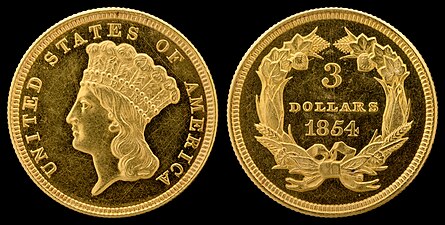
Longacre's design for the three-dollar piece (above) was adapted for the Types 2 and 3 gold dollar.
The Act of February 21, 1853, that had lightened the silver coins also licenced a metal three-dollar piece, which began to be produced in 1854. To ensure that the three-dollar piece was not incorrect for other gold coins, it had been successful thinner and wider than it would normally be, and Longacre put a distinctive design with an Amerindian language princess on it. Longacre adapted some the proficiency and the design for the gold dollar, which was made thinner, and thus wider. An adaptation of Longacre's princess for the big gold coin was placed connected the dollar sign, and a similar agricultural wreath on the reverse. The idea of making the gold one dollar bill bigger in this mode had been advisable in Congress as early as 1852, and had been advocated aside Pettit, but Guthrie's desire for an annulate coin stalled the matter.[19] [30] In May 1854, Snowden transmitted Guthrie a letter stating that the difficulties with an annular coin, especially in getting the coins to eject properly from the press, were more than trivial.[31]
Nonetheless, the Typewrite 2 amber dollar mark (Eastern Samoa it came to be known) proved unsatisfactory as the mints had difficulty in striking the unused coin so that whol inside information were brought come out. This was due to the high relief of the design—the three Southern branch mints especially had trouble with the opus. Many of the Typewrite 2 pieces promptly became illegible, and were dispatched hindmost to Philadelphia for melt and recoinage.[32] On most surviving specimens, the "85" in the date is non fully detailed.[33] The Type 2 gold dollar was struck only at Philadelphia in 1854 and 1855, at the three Gray branch mints in the latter year, and at San Francisco in 1856, after the design was designated for replacement.[26] [32] To correct the problems, Longacre enlarged the head of Liberty, making it a scaled-down version of the three-one dollar bill pick, and moved the lettering on the obverse closer to the rim. This built the metal flow and figure sharpness so practically that early numismatic scholars assumed the reverse was also neutered, though in fact no change was made and the Type 2 and Type 3 reverses are identical.[31] [33]
Design of Type 2 and 3 dollars [edit]
The Type 2 and 3 gold dollars depict Liberty as a Native American princess, with a fanciful feathered headdress not resembling any clapped out past any Indian tribe. This envision is an liberal copy of the design Longacre had made for the three-buck piece, and is one of a keep down of versions of Liberty that Longacre created based on the Venus Accroupie or Crouched Urania, a sculpture then connected display in a Philadelphia museum. For the reverse, Longacre adapted the "agricultural wreath" he had created for the reverse of the triplet-dollar man, composed of cotton wool, Zea mays, tobacco, and wheat, blending the bring forth of North and Southbound. This wreath would appear, later in the 1850s, happening the Flying Eagle centime.[32] [34]
Art historian Cornelius Vermeule deprecated the Indian princess project used away Longacre for the obverses of the Types 2 and 3 gold dollar mark, and for the three-dollar piece, "the 'princess' of the gold coins is a Federal Reserve note engraver's[c] high-toned version of family line art of the 1850s. The plumes or feathers are many like the crest of the Prince of Wales than anything that saw the Western frontiers, save perhaps on a music hall lulu."[34]
War years [edit]
The gold dollar continued to be produced in the belatedly 1850s, though mintages declined from the figures of deuce meg or much to each one twelvemonth between 1850 and 1854. Only when roughly 51,000 gold dollars were produced in 1860, with all over cardinal-thirds of that number at Philadelphia, antitrust under a third at San Francisco, and 1,566 at Dahlonega.[35] Around a hundred are known of the last, creating one of the zealous rarities from Dahlonega in the serial publication.[36]
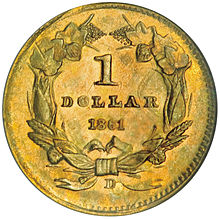
The other candidate for the rarest from that mint is the 1861-D, with an estimated mintage of 1,000 and perhaps 45 to 60 known.[37] Two pairs of dies were shipped from Philadelphia to Dahlonega on December 10, 1860; they arrived on January 7, 1861, fortnight before Georgia voted to secede from the Union, as the American Civil State of war began.[38] Under orders from Governor Joseph E. Brown, state militia secured the mint, and at some point, small quantities of dollars and half eagles were produced. Records of how many an coins were struck and when have not survived. Since dies crack in fourth dimension, and all the mints were furnished with them from Philadelphia, coining could not last, and in May 1861, coins and supplies left at Dahlonega were turned complete to the treasury of the Dixie of US, which Georgia had by then united. Metallic coins with a absolute face value of $6 were put away for assay. Normally, they would have been sent to Philadelphia to await the following year's meeting of the USA Assay Commission, when they would live available for examination. Instead, these were sent to the initial Confederate capital of Montgomery, A, though what was done with them in that respect, and their ultimate fate, are anon.. The oddity of the 1861-D dollar, and the association with the Confederacy, bring i it especially prized.[39]
Dahlonega, like the other two branch mints in the Southwesterly, closed its doors after the 1861 strikings. It and the Charlotte facility never reopened; the New Orleans Mint again struck coins from 1879 to 1909,[40] but did not fall gold dollars again. After 1861, the only issuance of aureate dollars outside Philadelphia was at San Francisco, in 1870.[41]
The outbreak of the Civil War shook public confidence in the Union, and citizens began billboard metal money, gold and silver medal coins. In late December 1861, Banks and so the federal United States Treasur stopped stipendiary out atomic number 79 at face value. Past middle-1862, all federal coins, even the base metal cent, had vanished from commerce in much of the land. The exception was the Far West, where mostly, only gold and silver were acceptable currencies, and paper money traded at a discount. In the take a breather of the nation, gold and silver coins could be purchased from Sir Joseph Banks, change agents, and from the Treasury for a superior in the new greenbacks the government began to issue to fill the disruption in commerce and finance the war.[42]
Final long time, abolition, and collecting [edit out]
Since metallic did not circulate in the United States (except on the Benjamin West Coast) in the postwar period, much of the production of coins of that metal in the U.S. government was double eagles for export.[43] Accordingly, although 1,361,355 gold dollars were struck in 1862—the last time yield would exceed a million—the mintage fell to 6,200 in 1863 and remained low for the rest of the coin's creation, excepting 1873 and 1874. The Mint felt it improper to suspend coinage of a coin canonised by Congress, and issued proof coins (generally a few dozen to the tiny numismatic community of interests) from specially-polished dies, also producing enough circulation strikes thusly that the proof coins would not be unduly rare. In 1873 and 1874, darkened and worn gold dollars held past the government were melted and recoined, generating large mintages of that denomination. This was done in anticipation of the resumption of specie payments, which did not occur until the end of 1878. Erst metal money once more circulated at face value, the gilt one dollar bill found No place in commerce amid large quantities of silver neologism, either released from billboard or fresh struck by the Mint.[41] [44] The government expected that the resumption of specie payments would cause the dollar and other small gold coins to diffuse again, but the public, allowed to redeem paper money, continued to use it as more convenient than coins.[45]
In the 1870s and 1880s, public interest grew in the contrabass-mintage chromatic buck. Collecting coins was seemly more than popular, and a number of numismatists put away some gold dollars and hoped for increases in measure. The Mint most likely channeled its production through some fortunate Philadelphia dealers, though trial impression coins could be purchased for $1.25 at the cashier's window at the Philadelphia facility. Banks charged a insurance premium for circulation strikes. They were popular in the jewelry barter, mounted into various items. The coins were often exported to China or Nihon, where such jewellery was made. The dollars were often damaged in the process; the Mint refused to sell into this trade and did its best to hinder it. Yet, Mint officials concluded that jewelers were prospering at acquiring the majority of each issue. Proof mintages exceeded 1,000 past 1884, and remained above that German mark for the remainder of the series, numbers likely inflated by agents of jewelers, willing to pay the Mint's premium of $.25 per coin.[46] Another use for the chromatic buck was as a holiday empower; afterwards its abolition the quarter eagle became a popular present.[47]
Epistle of James Pollock, in his final report as Mint Director in 1873, advocated limiting striking of Au dollars to depositors who specifically requested information technology. "The gold dollar is non a favourable mint, on account of its small size, and it suffers more proportionately from abrasion than larger coins."[48] His successors called for its abolishment, with James P. Kimball, before he left office in 1889, writing to Congress that except as jewellery, "little operable habituate has been found for this coin".[49] Later that year, the refreshing director, Edward O. Leech, issued a report stating that the gold dollar "is too small for circulation, and ... [is] secondhand almost exclusively for the purposes of embellish.[49] The last yr in which the gold dollar mark was stricken was 1889.[41] Carnal knowledge abolished the gilded dollar, along with the three-centime nickel and three-dollar piece, by the Act of September 26, 1890.[50]
A total of 19,499,337 Au dollars were coined, of which 18,223,438 were struck at Philadelphia, 1,004,000 at New Orleans, 109,138 at Charlotte, 90,232 at San Francisco and 72,529 at Dahlonega.[51] Accordant to an advertisement in the February 1899 supply of The Numismatologist, gold dollars brought $1.80 from each one, still in demand A a natal day present and for jewelry. That diary in 1905 carried news of a client depositing 100 gold dollars into a bank; the teller, awake of the value, credited the account with $1.60 per mint. In 1908, a dealer offered $2 each for any quantity.[52] American Samoa coin collecting became a widespread interest in the early 20th century, gold dollars became a touristy specialty, a status they retain.[53] The 2022 edition of R.S. Yeoman's A Guide Account book of United States of America Coins rates the least expensive metal clam in very fine condition (VF-20) at $300, a value given for each of the Type 1 Philadelphia issues from 1849 to 1853. Those seeking ace of each type bequeath receive the most expensive to represent a specimen of the Type 2, with the 1854 and 1855 estimated at $350 in that condition; the other two types have dates valued at $300 in this grade.[54]
Gold Sacagawea dollar [edit]
In 1999, the Philadelphia Mint struck 39 Sacagawea dollars (dated 2000 and the "W" peck mark of the West Point Mint) in 22 kt gilt.[55] The Tidy sum planned to sell gold Sacagawea dollars to collectors, but this project was halted after Congressmen questioned the Mint's authority to strike dollars with a composition other than the one authorized.[56] 27 of these coins were destroyed soon after they were minted, and the left over 12 flew along Space Shuttle Capital of South Carolina during STS-93.[57] Afterwards the coins were displayed at varied private events ahead being transferred to United States Bullion Depository at Fort John Knox.
The coins were publicly displayed for the front time at the Earth Numismatic Connection's World's Sportsmanlike of Money in 2007. Afterwards they were returned to Fort Knox.[58]
Commemorative gold dollars [edit]
The gold dollar had a abbreviated resurrection during the full stop of Early United States commemorative coins. Betwixt 1903 and 1922 nine different issues were produced, with a aggregate mintage of 99,799. These were minted for various public events, did non circulate, and no used Longacre's design.
References [delete]
Explanatory notes
- ^ Later honcho engraver. See Taxay, p. 204. The incumbent chief engraver, William Kneass, had been partially incapacitated by a stroking in 1835, though he retained his office. See Taxay, pp. 170–171, 176
- ^ Formally, "Engraver to the U.S. Mint at Philadelphia"; atomic number 2 had zero glutted-time helper engravers then. The office came to be celebrated Eastern Samoa "Chief Engraver" tardive. See Bowers 2004, p. 25
- ^ As was Longacre, before he became principal engraver
References
- ^ Taxay, p. 50.
- ^ Taxay, p. 66.
- ^ a b c Bowers 2011, p. 1.
- ^ Yeoman, pp. 377–378.
- ^ Taxay, pp. 200–201.
- ^ Taxay, p. 200.
- ^ Taxay, p. 201.
- ^ Bowers 2001, p. 77.
- ^ a b Taxay, p. 203.
- ^ Bowers 2011, p. 3.
- ^ a b Taxay, p. 204.
- ^ Taxay, pp. 205–206.
- ^ Bowers 2006, p. 56.
- ^ a b Taxay, p. 206.
- ^ Bowers 2004, p. 25.
- ^ Bowers 2011, pp. 4–5.
- ^ a b Bowers 2011, p. 5.
- ^ Bowers 2011, p. viii.
- ^ a b Breen, p. 476.
- ^ Bowers 2011, p. 4.
- ^ Bowers 2011, pp. 62–75.
- ^ Yeoman, pp. 427–428.
- ^ Bowers 2011, pp. 63–64.
- ^ Snow, p. 223.
- ^ Yeoman of the guard, p. 240.
- ^ a b Yeoman, p. 241.
- ^ Bowers 2011, pp. 5–6.
- ^ Bowers 2011, p. 6.
- ^ Taxay, pp. 209–210.
- ^ Taxay, pp. 210–211.
- ^ a b Taxay, p. 211.
- ^ a b c Breen, p. 479.
- ^ a b Bowers 2011, p. 7.
- ^ a b Vermeule, p. 55.
- ^ Yeoman, pp. 241–242.
- ^ Bowers 2011, p. 170.
- ^ Bowers 2011, p. 176.
- ^ Breen, p. 482.
- ^ Bowers 2011, pp. 13, 177.
- ^ Bowers 2011, pp. 12–14.
- ^ a b c Yeoman, p. 242.
- ^ Taxay, pp. 227, 231.
- ^ Bowers 2011, pp. 7–8.
- ^ Bowers 2011, pp. 7–9, 214, 222.
- ^ Bowers 2001, pp. 90–91.
- ^ Bowers 2011, pp. 8, 21.
- ^ Bowers 2011, p. 25.
- ^ Bowers 2011, p. 221.
- ^ a b Bowers 2011, p. 9.
- ^ Taxay, pp. 387–389.
- ^ Bowers 2011, p. 10.
- ^ Bowers 2011, p. 26.
- ^ Bowers 2011, pp. 28–31.
- ^ Yeoman, pp. 240–242.
- ^ "2000-W Gold Substantiation Sacagawea Dollar". www.smalldollars.com . Retrieved 2022-09-02 .
- ^ Gilkes, Paul (March 8, 2010). "Special 2000–W Sacajawea Dollars Travel on Quad Shuttlecock". Coin World: 122.
- ^ "US Mint to show unseen gold space coins | collectSPACE". collectSPACE.com . Retrieved 2022-06-27 .
- ^ "US Mint Displays Never–Before–Seen Gilded Space Coins in Milwaukee | U.S. Mint". www.usmint.gov . Retrieved 2022-06-27 .
Bibliography
Books:
- Bowers, Q. David (2001). The Harry W. Bass, Jr. Museum Sylloge. Dallas, TX: Chivvy W. Bass, Jr. Instauratio. ISBN0-943161-88-6.
- Bowers, Q. David (2004). A Guide Book of Double Eagle Atomic number 79 Coins. Atlanta, Empire State of the South: Marcus Whitman Publication. ISBN978-0-7948-1784-8.
- Bowers, Q. David (2011). A Pass around Book of Gilded Dollars (2nd ed.). Atlanta, GA: Whitman Publication. ISBN978-0-7948-3241-4.
- Bowers, Q. David (2006). A Draw Reserve of Shield and Liberty Chief Nickels. Atlanta, GA: Whitman Publishing. ISBN0-7948-1921-4.
- Breen, Walter (1988). Walter Breen's Complete Encyclopedia of U.S. and Colonial Coins. Novel York: Doubleday. ISBN978-0-385-14207-6.
- Snow, Richard (2009). A Guide Book of Flying Eagle and Indian Head Cents. Atlanta. GA: Whitman Publishing. ISBN978-0-7948-2831-8.
- Taxay, Don (1983). The U.S. Mass and Coinage (reprint of 1966 ed.). Recently York: Sanford J. Durst Numismatic Publications. ISBN978-0-915262-68-7.
- Vermeule, Cornelius (1971). Numismatic Art in America . Cambridge, MA: The Belknap Press of Harvard University Press. ISBN978-0-674-62840-3.
- Yeoman of the guard, R.S. (2022). A Guide Hold of America Coins (The Administrative unit Red River Book) (67th ed.). Battle of Atlanta, GA: Whitman Publishing. ISBN978-0-7948-4180-5.
What Gold Dollar Coins Are Worth Money
Source: https://en.wikipedia.org/wiki/Gold_dollar
Posted by: nationsanney1981.blogspot.com
0 Response to "What Gold Dollar Coins Are Worth Money"
Post a Comment