

How Does Bayrons Make Up Dark Matter How Does Bayrons Makeup Dark Matter
1. Introduction
The latest results on the cosmological parameters [1] reveal that only 4.ix% of the content of the Universe is in the form of baryonic matter whereas 26.8% is constituted past nighttime matter. The rest is accounted for by the mysterious nighttime free energy. If we focus on the thing front so two agonizing questions are readily asked: What is the nature of nighttime matter? and why is its density so close to the baryonic matter density, i.due east., Ω DM ~ 5Ω B ?
Moreover, the in a higher place-mentioned visible affair density does not include anti-baryons i.e., the visible universe is asymmetric with an initial excess of baryons over anti-baryons parametrized by η(b) = (nb − north b )/s ~ 10−ten, where n denotes the number density and due south the entropy density. Therefore, some other fundamental question is what is the origin of the observed baryon asymmetry of the universe (BAU)?
This puts finding the nature of DM and the mechanism backside baryogenesis at the top of the agenda of modern physics1. While the solutions to these two problems might well exist unrelated to each other, it is yet tempting to assume the new physics to be minimal and unifying enough so that information technology solves both of them with the same ingredients. Moreover, if we discard uncomplicated numerical coincidence as an explanation to the intriguing closeness of matter densities, nosotros are left with the task to construct theories relating them or unifying their genesis.
Indeed, numerous models have been proposed in the recent years to accomplish this end. Broadly speaking, there are 3 approaches that are followed to chronicle nighttime matter to baryons. The first idea is that at that place is a sector connecting DM and baryons in the early universe. The connecting sector acts either equally a parent sector, generating DM and baryons through decay for instance, or as a mediator machinery transferring the asymmetry from the night to the baryonic sector or vice versa. Asymmetric DM models (see beneath) used this arroyo extensively. The second approach uses the DM sector as an auxiliary to a successful baryogenesis scenario. The force of the stage transition in electroweak baryogenesis may for case be enhanced past the presence of DM. The 3rd arroyo uses the thermal WIMP epitome as a framework to relate the abundances.
The purpose of this mini-review is to provide a succinct notwithstanding global motion picture on these models focusing on the fundamental concepts and ingredients that are used in each reviewed model and on the predictions that are made. While there are some similarities between these models, information technology is difficult to classify them in a consistent and easy way. Instead we opt for a diagrammatic approach Figure 1 and we review models that follow the main roads of the schematic. It is not our goal to exist exhaustive with the references and we will refer to more systematic reviews when possible.
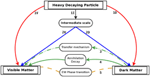
Figure i. A schematic of the different mechanisms relating DM to baryon disproportion. The lines are the different stages of the considered machinery. The labels on the lines are used to draw the model.
From the baryogenesis side we know that any machinery that satisfies the three Sakharov condition[6]: B violation, C and CP violation and divergence from thermal equilibrium can atomic number 82 to a successful BAU. Whereas from the cold dark matter side nosotros can generally speak of three classes of candidates: weakly interacting massive particles (WIMPs), disproportionate dark matter (ADM) and not-thermal nighttime matter (NTDM)2.
In principle, we can organize the paper in terms of either 1 of these categories, we chose however to focus on the DM nature.
The paper is organized every bit follows. In section 2 we review models relating DM to the baryon asymmetry while preserving the WIMP miracle. Section 3 is devoted to ADM models, where we will review different mechanisms and highlight the key concepts that are needed to construct them. In section iv we quickly mention the possibility of non-thermal DM. Finally we summarize the different models and the roads taken in Tabular array 1. To simplify the understanding of the different models, we will specify in the text (in bold face) whenever it is helpful and in the table the path that is followed in the schematic. Nosotros will use the following convention: A * denotes the stage in the diagram where a new asymmetry appears while a bar on the superlative means that the direction of the arrow is flipped. We volition as well use the letter T to refer to a thermalization stage.
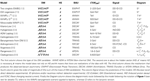
Table 1. Summary of the models presented in this review and others.
2. WIMP Night Matter Models
Information technology has been noted that relic particles from a thermal bathroom provide in a miraculous manner the correct relic density of DM. Indeed, the number density of dark particles in the primordial thermal bathroom is frozen-out when the expansion charge per unit drops below the charge per unit of the dark affair interactions. The affluence of the relic particle scales then as:
where 〈σv〉f.o. is the thermal average of the annihilation cross-section of DM times the relative velocity at the time of freeze-out. Which gives the observed abundance for weak interactions cross-sections. This coincidence between DM and the weak calibration has been dubbed the WIMP phenomenon. In addition to easily providing the observed relic abundance of DM, the WIMP paradigm is falsifiable. It offers a very rich array of phenomenological tests from underground straight detection experiments to astrophysical signals passing past colliders. Without whatsoever doubtfulness, maintaining the success of the WIMP image and extending it to related DM to the baryon disproportion is an attractive possibility. In this section we review the main theories attaining this goal.
ii.one. Electroweak Baryogenesis
Electroweak baryogenesis is an highly-seasoned minimal scenario of baryogenesis based on the realization of the third Sakharov condition at the electroweak stage transition, run across [5] for a review on the machinery. In the SM a strong first order phase transition, which is necessary in this scenario, requires a very light higgs boson (<42 GeV), moreover the corporeality of CP violation in the SM is not enough to accommodate the observed BAU. These two considerations imply the need for new physics in order to have a successful baryogenesis and this is where DM comes in. The idea is to use the DM itself (or the dark sector particles) to make this scenario compatible with the SM higgs. A minimal extension of the SM with an actress (complex) scalar [7–eleven] or ii charged singlets [12] achieves this goal, although contempo data from LHC and WIMP direct detection experiments render this possibility less attractive considering such a DM would have to be sub-ascendant (i.e., cannot account for the full density of DM). The same applies for inert higgs extensions of the SM [13] (higher SU(2) representations were considered in [fourteen, fifteen]). However, models with vector-similar fermions are able to produce the full DM density and BAU for a wide range of masses [16].
An even more extended higgs sector, say a two-higgs-doublet model improves further the prospects of this scenario by providing the needed CP phases [17, 18]. There is no direct correlation between DM and baryonic abundances in such theories, however the presence of the night sector is necessary to have a successful baryogenesis which at the same fourth dimension constrains the DM mass and couplings. Lastly, LHC and WIMP direct detection experiments may be used to constrain or rule out such a possibility. We note in passing that there are also models based on leptogenesis that follow the same philosophy outlined here, as in [nineteen–21].
2.ii. WIMPy Baryogenesis
Another possibility linking WIMP DM to the baryon disproportion is the WIMPy baryogenesis model [22]. Here the baryon asymmetry arises from WIMP annihilation instead of the disuse of some heavy state like for instance in the usual leptogenesis mechanism. It has been remarked that the anything of DM in the early universe can satisfy the Sakharov conditions and leads to a cyberspace baryon asymmetry and the observed WIMP relic density.
The baryon asymmetry generated with the WIMP anything can be washout from two kind of processes: inverse anything of baryons into DM and baryon to antibaryon processes. Therefore, the main requirement for any available WIMPy baryogenesis scenario is that washout processes must freeze-out before that WIMP freeze-out. Inverse annihilations are Boltzmann suppressed for T < m DM merely baryon to antibaryon washout can be relevant also for T « m DM. One style to suppress such a processes is by introducing an exotic heavy antibaryon ψ to which WIMP annihilate through the process DMDM → Bψ where B is a SM baryon. If the exotic antibaryon ψ has mass m ψ > m DM, for T < m DM its affluence is Boltzmann suppressed and therefore the baryon to antibaryon washout processes are suppressed. And so the condition is
where the last status comes from kinematic. B (Fifty) violation is achieved by annihilating the DM to two sectors: baryons (leptons) and exotic antibaryons (antileptons) that are individually asymmetric but together symmetric. It is important that the decay of the exotic particles exercise non erase the baryon asymmetry generated in the SM sector. For this extra symmetry is required to decouple the exotic fields from the SM.
Solving the model-contained Boltzmann equations for the WIMPy baryogenesis framework, information technology is possible to evidence that the baryon disproportion is proportional to the DM density at the time of freeze-out of the washout processes, i.e.,3
where Y DM wo is the DM density at the washout while Y B,DM are the observed baryon and DM densities and ϵ is the baryon-antibaryon disproportion. From Equation (iii) and the relation
it follows that Y DM wo » YDM , namely it is crucial to freeze-out the wash out processes before the WIMP freeze-out temperature otherwise whatsoever generated asymmetry would be quickly erased.
As a concrete example we consider a realization of the WIMPy idea in which the WIMP annihilate to leptons generating a lepton asymmetry then converted into a baryon disproportion through sphaleron like in leptogenesis. The DM candidate consists of a pair of gauge singlet Dirac fermions Y and Y . In addition to DM two new weak-calibration states ψ (fermion SUL (2) doublet) and S ane and S ii (pseudo-scalar guess singlets) are added. The fields {Y, Y , ψ, ψ, Si } transform under an actress Z four symmetry respectively as {+i, −i, −ane, −ane, −1}. The Lagrangian contains the actress terms

Since in that location is more than one scalar Si , information technology remains a relative complex stage between the λ couplings. And so as in the mutual leptogenesis instance the interference betwixt tree level and loop diagrams give rise to CP violation resulting in an asymmetries in Fifty (4*)4 and subsequently converted to B asymmetry past ways of the sphalerons. Here differently from leptogenesis, the dark affair Y annihilates into SM leptons Fifty and ψ through the pseudo-scalars (T)5 then a lepton asymmetry also accumulate in ψ. The processes linking ψ to the SM exercise not erase the lepton asymmetry thanks to the actress Z 4 symmetry that decouples ψ from the SM.
At the stop an asymmetry is generated from a 2 → 2 process instead of a 1 → 2. An important requirement is that g ψ > mY because it implies that the dominant washout process Lψ → L † ψ † is Boltzmann-suppressed when DM is annihilating. We summarize diagrammatically the signature of the model every bit (T–iv*), as it appears in the Table ane.
The detection prospects are rich in this scenario and include direct (for models with annihilation to quarks), indirect detection (anti-deuteron) and collider signals. Encounter [23, 24] for a general phenomenological study of this form of models. Other models preserving the WIMP miracle and attempting to relate the DM to BAU can be institute in [25, 26].
2.3. Meta-Stable WIMP
As in the case of WIMPy baryogenesis, this model [27] attempts to explicate the DM/baryon relic density coincidence using the WIMP miracle. The idea is to use a decaying WIMP instead of a stable one. A thermal WIMP Y freeze out at a temperature Tf that is typically Tf ~ mY /20. At freeze out the WIMP density is YY (Tf ) which is equal to the DM density today YY (Tf ) ≃ YY (T 0) if the WIMP is stable. The authors consider two kinds of WIMPs: one stable Y i that is the DM candidate and one Y 2 that decay after freeze out, with the densities of the two WIMPS at the freeze out being almost the same Y Y 1 (Tf ) ≈ Y Y 2 (Tf ). The density of the decay WIMP at the freeze out temperature is the initial condition for the baryogenesis.
The meta-stable WIMP Y 2 decays after thermal freeze-out into baryons in such a way that the baryon number B and CP are violated. In a minimal realization of the idea, the SM is extended to include a di-quark scalar ϕ and ψ which are Majorana fermions and a singlet scalar South. The relevant couplings are
Where u and d are the SM quarks. The scalar S mediates the thermal annihilation of Y 2 Y two into SM. The meta-stable WIMP decay as Y 2 → uϕ* followed by the decay of ϕ → dd. A CP asymmetry ϵ CP in Y ii → uϕ* and Y 2 → u ϕ arises from the interference between the tree-level diagram with the i loop diagram mediated by ψ (that shares with Y 2 the same breakthrough numbers). In order to generate a baryon disproportion the WIMP must disuse before the BBN and after WIMP freeze out, i.e., TBBN < T Y 2 < Tf . Solving the Boltzmann equations it is possible to find the baryon density today
Using the relations YY (Tf ) ≈ Y Y ii (Tf ) and that YY (Tf ) ≃ YY (T 0) we arrive at the result
where Ω DM is the relic abundance of the DM. The model lies at the electroweak scale and therefore information technology can exist probed in colliders.
iii. Asymmetric Night Affair Models
ADM [28–35] is a class of DM models often seen as an alternative to the WIMP paradigm. The rationale of ADM is based on the hypothesis that DM affluence is, similarly to baryons, only the surviving asymmetric role of the initial density and is of the same order as the baryon asymmetry, i.east.,
where Y denotes the DM particle. The motivation comes from the fact that the observed DM and visible affair abundances are remarkably close to each other. These models usually lead to a relation between DM mass and proton mass: One thousand DM ~ fiveMP in contrast with WIMP DM models where the calibration of reference is the weak scale. The relation between the DM mass and the proton mass is however non explained except in some models based on hidden sectors such as in mirror worlds [36–38], models with a dark QCD [39] or composite models (see beneath).
ADM can exist implemented in many ways leading to a very rich theoretical and phenomenological mural. While information technology is difficult to classify these models in a straightforward way, it is however enriching to highlight the key principles they unremarkably rely on. Basically two main approaches are followed: (1) Dark and visible matter asymmetries are generated at the same time. This is ordinarily achieved with the decay of a heavy particle. (ii) The asymmetry is generated in the dark sector then is transferred (via sphaleron processes, higher dimension operators or renormalizable interactions) to the visible sector or vice versa. It is also necessary to pass at some betoken past a thermalization phase to get rid or to avoid the production of the symmetric function of DM (a less farthermost cancelation of the asymmetric part leads to mixed scenarios betwixt WIMP and ADM [xl]).
We will nowadays hither ADM models explicitly showing the key assumptions and principles used as well equally their phenomenological bear upon. They brand use of the master ADM concepts and pass by the main diagrammatic roads. For a recent review and an exhaustive list of reference we refer the reader to [41–43] and for a more succinct overview [44].
three.1. Blended ADM
The idea of the ADM has been proposed in the seminal work of Nussinov [28] who suggested that in analogy with the visible sector's baryon asymmetry, a technibaryon asymmetry is a natural possibility. This idea has been recently revamped in the context of walking dynamics [45–48]. If the model is arranged such that the lightest technibaryon (LTB) is neutral and stable, the density of the LTB scales as:
Where mp is the proton mass, m TB is the mass of the LTB. TB and B are the technibaryon and baryon number densities, respectively. This is the typical scaling of ADM models.
The model discussed in [45] is a technicolor theory based on the SU(4) global symmetry spontaneously broken downwards to And so(four). Such a breaking gives rise to ix Goldston bosons, three of them corresponding to the SM estimate bosons. The remmant 6 Goldstone bosons carry technibaryon charge and the lightest of them (LTB) is the DM candidate6. In [49, 50] the backdrop of blended (asymmetric or symmetric) dark matter candidates have been computed in item via offset-principle lattice simulations.
3.2. Kitano-Low
The model implemented in [34] considers a machinery originally proposed in [31] to unify in an elegant way the abundances of DM and baryons. It is a prototype of the ADM models based on decay of a field connecting the night and visible sectors.
The authors postulate a new symmetry, namely a Z two parity, under which the SM particles are neutral and new particles are charged, forming a nighttime or hidden sector. The lightest of the hidden particle is stable and is a DM candidate. A generalized B-L number is unbroken and is shared between the SM and the dark sector, thus any excess of B-L that is generated in 1 of the 2 sectors is compensated past the same excess in the other sector. Later on baryogenesis the interactions betwixt the visible and the night sectors become negligible and the B-Fifty excesses are separately conserved in the two sectors giving a relation between the visible and dark relic densities.
A simple model realizing the thought consists of a heavy particle P, a messenger particle X which carries a color charge and the DM candidate Y, all odd under the Z 2 while the SM is even. The mechanism passes through three stages. In the first stage P has CP-violating out of equilibrium decays into SM and to a lighter messenger X generating an excess in both sectors but preserving the generalized B-50 globally. Then is assumed that beneath the baryogenesis temperature the two sector are decoupled and the 2 asymmetries are conserved such that nosotros take:
In the second stage the dark 10 messenger demolish away its symmetric role with X through judge interactions and we are left with its disproportionate part merely. In the 3rd and terminal stage the decay of Ten to DM particle Y and therefore
giving a tight relation between the visible (baryonic) and DM number densities. To ensure that such a relation exists it is of import that 10 is long lived enough such that it decays later on its symmetric part cancels out.
We summarize the machinery: Decay of P that produces the asymmetries in Ten (1* I ) and SM (i* V , since an disproportion in the visible sector is generated past the disuse) followed by symmetric annihilation of X (T) and finally the decay of X to the lightest dark particle Y (2 D ). We announce the total machinery in a meaty way as (1* V –1* I –T–2 D ).
An interesting possibility is to consider X itself as the DM particle. This possibility is not possible here hither because of charge assignment of X (colored particle). Notwithstanding, we will see now that Hylogenesis realizes this possibility. Notation that the original asymmetry can be generated through the Affleck-Dine [51, 52] mechanism in a SUSY framework [53–56] or through leptogenesis as in [57].
3.3. Hylogenesis
This model [58] is based on a hidden sector composed of 3 Dirac fermions X 1, Ten two, Y and a complex scalar ϕ. It is assumed that 1000 ϕ ~ GrandY ~ GeV and TeV < Grand X one < M 10 2 . Xi are made to couple to the visible sector through the neutron portal (Xi dc uc dc ), the relevant terms in the Lagrangian are:

The particle content and the symmetries of the model permit the definition of a generalized baryon number (B), conserved past both sectors, nether which BX = −(BY + B Φ) = 1 as well equally non-reducible CP phases.
In the early universe an equal number of X one and its antiparticle X 1 are generated non-thermally (e.chiliad. during reheating) and the total baryon number is zero at this stage. Then both states X 1 and X 1 decay into the visible and subconscious states as X ane → udd (1* Five ) and X 1 → Y Φ* (1* D ) and their conjugates at tree level and through loops (including the lighter dark particles ϕ and Y), generating an asymmetry in the visible sector ϵ V and an asymmetry in the hidden sector ϵ D á la leptogenesis
where Γ Ten 1 is the full rate and ϵ D can be obtained in a similar fashion. We take
Because 10 1 is a Dirac particle, the disproportion generated in the visible sector is then translated equally an asymmetry in the hidden sector. Indeed, CPT invariance forces the particle and its anti-particle to have equal full decay rates Γ[Ten i → due north + Y Φ*] = Γ[ 10 i → n + YΦ], which translates every bit a relation between asymmetries, that is ϵ D = −ϵ V where we take used the Equation (15). Therefore, in the decay of X 1 and X 1 a baryon number is generated in the visible sector and an equal and contrary baryon number is generated in the hidden sector so that the full baryon number is nothing. The two asymmetries are frozen-in thanks to the weakness of the interactions between the two sectors.
The last step is to cancel out the symmetric part of the dark thing particles and this is achieved for instance with an extra U(one) D estimate symmetry in the subconscious sector under which Y and Φ have opposite charges and Ten 1,two are neutral. The symmetric office is depleted (T) by the annihilation processes Y Y → Z′Z′ and ΦΦ* → Z′Z′ with thou Z′ < 1000 Y, Φ ~ GeV (this is consequent with present observations for 10−6 < κ < x−2) with Z′ decaying to SM through photon. These cross section are much larger to the one demand to obtain the correct DM relic density by thermal freeze-out. Then the DM density is given by the residue asymmetric component and we are and then left with the relation:
that gives a strong relation between the visible and dark matter abundances:
Nosotros denote in a compact manner this mechanism with the signature (i* V –1* D –T). Because of the neutron portal, hylogenesis provides an interesting signature of the DM: the induced proton decay (IND). Indeed DM tin scatter with protons producing mesons ϕ*p → YK +.
3.4. ADM from Leptogenesis
If we take Majorana instead of Dirac decaying fields in the previous model, we get different consequences on the DM mass. The model considered in [59] is based on the decay of a heavy right handed neutrino field N.
The model is an extension of the SM and consists of ii right-handed neutrinos and a scalar ϕ and fermion Y gauge singlets, charged under an extra Z ii parity, that made the hidden sector

N couples to the SM with Dirac Yukawa coupling and to the hidden sector, Y is the DM candidate. Therefore, N can decay (out of equilibrium) simultaneously as North → LH (1* Five ) and N → Yϕ (1* D ) generating two different and unrelated CP-asymmetries ϵ L and ϵ DM respectively. Hither N is a Majorana particle and CPT does not imply that |ϵ L | = |ϵ DM | like in Hylogenesis (run into previous section). The DM must be a Dirac particle in club to preserve a lepton number. Because both Y and ϕ are charged under the extra Z 2, the DM is stable and the hidden sector can interact with the SM but past means of the heavy correct-handed neutrino. In lodge to cancel out the symmetric component of the DM, an boosted gauged U(1) interaction is imposed to annihilate the Y, Y pair. We are left with the asymmetric parts of Y (T). The DM and baryon density Ω DM /Ω B is then proportional to the ratio of the CP-asymmetries ϵ DM /ϵ L ,
where η DM,L are the washout factor. Therefore, the DM mass tin can be very different from the value of 51000p given in most ADM models. A similar model based on type-II leptogenesis instead of blazon-I has been proposed in [sixty]. See also [57] for an earlier ADM model based on leptogenesis and where the DM mass is in the typical few GeV scale.
3.5. Darkogenesis
In this model [61] an asymmetry is generated in the dark sector and is then transferred to the visible sector. The DM disproportion arises from a first club dark phase transition in the subconscious sector to which the SM does not participate. The dark baryogenesis go on through the symmetry breaking phase transition of a dark not-Abelian gauge group GD . The fields in the dark sector take a global night symmetry UD (1) which is anomalous under GD . During the symmetry breaking first guild phase transition an nighttime asymmetry is generated by ways of CP violating interactions.
The asymmetry can exist transferred to the visible sectors in 2 ways: by fields that acquit both hidden and visible charges (perturbatively)or via electroweak sphalerons (not-perturbatively). In the concluding case, in order to transmit the asymmetry from the dark sector to the SM one, information technology is required a mediator charged nether both the SUL (ii) and the night symmetry UD (i). Then the dark number is dissonant under SUL (2) and the SM electroweak sphaleron can convert the asymmetry of the dark sector into an disproportion in the SM.
In the first case the connectors can consists of college order effective operators of the type
where Od is a dark sector operator like for instance Od = 10, 102 . The subconscious sector phase transition occurs at a temperature above the temperature at which the effective transfer operator freeze-out The night thing mass lies around v to xv times the mass of the proton.
Directly detection cannot falsify the darkogenesis mechanism, still the gravitational wave indicate from dark showtime society transition could in principle probe this mechanism. The asymmetry in the nighttime sector tin can likewise be generated via a dissimilar baryogenesis mechanism, see [62] for an case where a heavy particle decays to the dark sector, creating an asymmetry there that is then transferred to the visible sector. For the opposite case, see [63] or aidnogenesis[64], for instance where the asymmetry is transferred through sphalerons from the SM to the dark sector. Diagrammatically nosotros announce this model every bit : *−iii−*, which ways that an original asymmetry in the dark sector (following the direction the arrow) is transferred to the visible sector. Run across also [65] for a recent model where sphalerons are responsible for cogenerating the nighttime matter.
3.6. Xogenesis
Similar in the darkogenesis model, here [66] a DM asymmetry is created and then transferred to the baryon by means of transfer operators. The problem of the creation of a DM disproportion is non addressed hither and the authors focuses on the transfer mechanisms. The primary difference between this mechanism and the classic ADM ones going in the same direction is that the DM mass can exist around the weak scale instead of the proton mass (for a dissimilar thought how to obtain heavy ADM see [67]) without fine-tuning the parameters. The main idea can be summarized as follows: If DM is not relativistic at the temperature where the transfer operator decouples TD then the DM number density undergoes a thermal suppression allowing the DM to exist heavy.
The transfer can be due from the SUL (2) sphalerons (or the exotic sphalerons of a new judge grouping) or lepton/baryon number violation from higher lodge operators. In whatever transfer scenario chemical equilibrium betwixt DM and baryon is maintained until the transfer operator decouples. When the transfer is active, we accept:
Given a specie i in full general its asymmetry north Δi = ni − n i is proportional to its chemical potential
The coefficients ci are office of the mass and temperature ci = ci (mi , T) [29]:
where g i is the statistical weight and R is the Robertson-Walker scale factor at temperature T. For small value of mi /T then f(mi /T) tend to a constant, while for large gi /T then f(mi /T) is very small
Typically merely the beginning possibility where m DM /TD « 1 is taken (T D is the decoupling temperature of the transfer operator). In this example from Equations (21) and (22) it follows that n Δ DM ~ n Δ B leading to the 'prediction' m DM ~ vmp . However, a 2nd solution is possible. If the ratio m DM /TD is large, and so the coefficients c DM is suppressed, meet Equations (22) and (24). This results in a lower n DM with respect to the case where the ratio mi /TD is pocket-sized and thus a larger DM is immune. For a given value of TD the not-relativistic solution give virtually m DM ~ 10 TD instead of 5GeV (relativistic solution), giving a mass for the DM of the guild of the TeV.
A simple example is given past a DM particle Y that transform equally a fermion doublet of SUL (2) with hypercharge +1/2. Since the DM is charged under SUL (2), information technology interacts with the SM sphaleron. Thank you to the sphaleron Y and quarks are in thermal equilibrium, therefore the DM and quarks chemical potential are releted, i.east., μ Y = −3 μ uL . In this example the decoupling temperature TD of the transfer operator is the temperature where the spahleron is no more agile, that is around 200 GeV. Solving equations (21) and (22) 1 gets for the DM a value of nearly 2000 GeV.
The idea has been illustrated with different classes of transfer operators: SM sphalerons, exotic sphalerons of a new gauge group and lepton or baryon number violation college order operators. Since the DM is heavy information technology will exist difficult to search for it simply new particles at the weak or TeV scale are tin be probed in collider experiments.
4. Non-Thermal Nighttime Matter Models
4.i. Cladogenesis
Cladogenesis [68] is based on the ascertainment that the dilution factor due to entropy release by moduli disuse is very close to the observed baryon asymmetry. Indeed for a modulus τ with a reheating temperature in the range MeV – GeV (corresponding to Thousand τ of order twenty–1000 TeV) the dilution factor is given by
a value that is close to η B and also to Y DM as long as M DM is within a cistron or two from the proton mass. At the same time whatsoever previous DM abundance volition be suppressed by the same gene. These considerations lead the authors of Cladogenesis to consider a not-thermal origin of DM from modulus decay. The scenario goes equally follow: τ decays to some species N (1 I ) and to DM (directly or via dark sector particles following 1 D ). The decay to DM must be suppressed down to ten−3 to achieve the observed relic abundance. N then decays to SM by violating baryon (or lepton) number and CP to produce the correct baryon asymmetry (2* 5 ). Note that the DM is not asymmetric in this model considering baryogenesis is washed in the visible sector only.
Another example of non-thermal mechanism is given in [69] where the DM arises from the out-off equilibrium decay of the inflaton instead of the moduli.
v. Summary
In this short review we have given an overview of the models linking the generation of the baryon disproportion of the universe and dark matter. These models are varied and diverse and tackle the problematic from different points of view. Models attempting to preserve the WIMP miracle lead to a very rich phenomenology and their couplings can be probed at LHC soon. These models do not address the coincidence betwixt the baryon and DM asymmetries and the link between the ii abundances is not strong. ADM models, ane the other hand, give a natural explanation to this ratio at the cost of WIMP phenomenology. Lastly non-thermal production models are even so some other possibility relating the genesis of the nighttime and visible sector. LHC and night affair search experiments volition probe big chunks from the theoretical landscape of DM, hopefully shedding light on its nature and on the machinery at piece of work for baryogenesis.
We summarize the models discussed here in Table 1 where we requite data about the nature of their DM, the BAU machinery at piece of work, the existence of a hidden sector, range of the DM mass allowed in the model as well as the expected signal. The concluding cavalcade shows the diagrammatic signature of the model based on Figure 1 and the convention outlined in the introduction.
Conflict of Interest Statement
The authors declare that the inquiry was conducted in the absence of any commercial or financial relationships that could exist construed as a potential conflict of interest.
Acknowledgments
Stefano Morisi thanks to DFG grant WI 2639/four-1 for fiscal support. Sofiane. One thousand. Boucenna was supported by the Spanish MINECO under grants FPA2011-22975 and MULTIDARK CSD2009-00064 (Consolider-Ingenio 2010 Plan), by Prometeo/2009/091 (Generalitat Valenciana), by the European union ITNUNILHC PITN-GA-2009-237920.
Footnotes
1. ^For reviews on DM we refer the reader to [2, three] and for baryogenesis to[four, 5].
2. ^Where we include whatever not-thermally produced DM that does not fall in the ADM instance.
3. ^>Hither YX is the ratio of the number density nX of the specie Ten with the entropy s.
4. ^The depiction of this pace in the schematic: the DM annihilates into the visible sector (line iv), with the * is there to show that an asymmetry is produced in this stride.
five. ^We use hither the letter T to emphasize that the DM is thermally produced.
half-dozen. ^The Goldstone bosons are supposed to pick up a mass from a higher scale.
References
ane. Ade PAR, Aghanim Northward, Armitage-Caplan C, Arnaud M, Ashdown Chiliad, Atrio-Barandela F. et al. Planck 2013 Results. XV I. Cosmological Parameters. (2013) arXiv: 1303.5076
two. Bertone K, Hooper D, Silk J. Particle nighttime affair: evidence, candidates and constraints. Phys Rept. (2005) 405:279–390. doi: x.1016/j.physrep.2004.08.031
CrossRef Full Text
iii. Bergstrom L. Nonbaryonic dark matter: observational evidence and detection methods. Rept Prog Phys. (2000) 63:793. doi: x.1088/0034-4885/63/5/2r3
CrossRef Full Text
4. Dine G, Kusenko A. The origin of the matter - antimatter disproportion. Rev Modern Phys. (2003) 76:one. doi: 10.1103/RevModPhys.76.1
CrossRef Full Text
5. Riotto A, Trodden G. Recent progress in baryogenesis. Ann Rev Nucl Part Sci. (1999) 49:35–75. doi: 10.1146/annurev.nucl.49.1.35
CrossRef Full Text
6. Sakharov Advertising. Violation of CP invariance, c asymmetry, and baryon disproportion of the universe. Pisma ZhEksp Teor Fiz. (1967) 5:32–v.
7. Profumo S, Ramsey-Musolf MJ, Shaughnessy Chiliad. Singlet higgs phenomenology and the electroweak phase transition. JHEP (2007) 0708:010. doi: x.1088/1126-6708/2007/08/010
CrossRef Full Text
8. Espinosa JR, Konstandin T, Riva F. Potent electroweak stage transitions in the standard model with a singlet. Nucl Phys. (2012) B854:592–630. doi: x.1016/j.nuclphysb.2011.09.010
CrossRef Full Text
ix. Barger V, Langacker P, McCaskey M, Ramsey-Musolf M, Shaughnessy G. Complex singlet extension of the standard model. Phys Rev. (2009) D79:015018. doi: 10.1103/PhysRevD.79.015018
CrossRef Full Text
10. Cline JM, Kainulainen K. Electroweak baryogenesis and dark affair from a singlet higgs. JCAP (2013) 1301:012. doi: ten.1088/1475-7516/2013/01/012
CrossRef Full Text
xi. Ahriche A, Nasri South. Light night thing, light higgs and the electroweak phase transition. Phys Rev. (2012) D85:093007. doi: ten.1103/PhysRevD.85.093007
CrossRef Total Text
12. Ahriche A, Nasri S. Night matter and potent electroweak phase transition in a radiative neutrino mass model. JCAP (2013) 1307:035. doi: 10.1088/1475-7516/2013/07/035
CrossRef Full Text
13. Cline JM, Kainulainen K. Improved electroweak stage transition with subdominant inert doublet dark thing. Phys Rev. (2013) D87:071701. doi: ten.1103/PhysRevD.87.071701
CrossRef Total Text
xiv. Chowdhury TA, Nemevsek M, Senjanovic G, Zhang Y. Dark matter as the trigger of strong electroweak phase transition. JCAP (2012) 1202:029. doi: ten.1088/1475-7516/2012/02/029
CrossRef Full Text
15. AbdusSalam SS, Chowdhury TA. Scalar representations in the light of electroweak phase transition and common cold dark matter phenomenology. (2013) arXiv: 1310.8152.
16. Fairbairn K, Grothaus P. Baryogenesis and dark affair with vector-like fermions. JHEP (2013) 1310:176. doi: 10.1007/JHEP10(2013)176
CrossRef Total Text
17. McLerran LD, Shaposhnikov ME, Turok Due north, Voloshin MB. Why the baryon asymmetry of the universe is approximately 10**-10. Phys Lett. (1991) B256:451–6.
18. Cline JM, Kainulainen K, Trott Chiliad. Electroweak baryogenesis in two higgs doublet models and B meson anomalies. JHEP (2011) 1111:089. doi: x.1007/JHEP11(2011)089
CrossRef Full Text
19. Basso L, Fischer O, van der Bij JJ. A natural Z′ model with changed seesaw and leptonic night matter. Phys Rev. (2013) D87:035015. doi: x.1103/PhysRevD.87.035015
CrossRef Full Text
20. Canetti L, Drewes M, Shaposhnikov Chiliad. Sterile neutrinos equally the origin of dark and baryonic affair. Phys Rev Lett. (2013) 110:061801. doi: 10.1103/PhysRevLett.110.061801
CrossRef Full Text
21. Canetti L, Drewes G, Frossard T, Shaposhnikov One thousand. Night thing, baryogenesis and neutrino oscillations from correct handed neutrinos. Phys Rev. (2013) D87:093006. doi: 10.1103/PhysRevD.87.093006
CrossRef Full Text
22. Cui Y, Randall L, Shuve B. A WIMPy baryogenesis miracle. JHEP (2012) 1204:075. doi: ten.1007/JHEP04(2012)075
CrossRef Total Text
23. Bernal N, Josse-Michaux FX, Ubaldi L. Phenomenology of WIMPy baryogenesis models. JCAP (2013) 1301:034. doi: 10.1088/1475-7516/2013/01/034
CrossRef Total Text
25. Davidson South, Elmer M. Similar nighttime matter and baryon abundances with TeV-calibration leptogenesis. JHEP (2012) 1210:148. doi: x.1007/JHEP10(2012)148
CrossRef Full Text
26. McDonald J. Baryomorphosis: relating the baryon asymmetry to the "WIMP miracle." Phys Rev. (2011) D83:083509. doi: 10.1103/PhysRevD.83.083509
CrossRef Full Text
28. Nussinov Due south. Technocosmology: could a technibaryon excess provide a "natural" missing mass candidate? Phys Lett. (1985) B165:55.
29. Barr SM, Chivukula RS, Farhi E. Electroweak fermion number violation and the product of stable particles in the early universe. Phys Lett. (1990) B241:387–91.
31. Kuzmin VA. A Simultaneous solution to baryogenesis and dark affair problems. Phys Function Nucl. (1998) 29:257–65. doi: 10.1134/ane.953070
CrossRef Full Text
32. Hooper D, March-Russell J, Westward SM. Asymmetric sneutrino dark affair and the Omega(b) / Omega(DM) puzzle. Phys Lett. (2005) B605:228–36. doi: 10.1016/j.physletb.2004.xi.047
CrossRef Full Text
33. Farrar GR, Zaharijas 1000. Nighttime matter and the baryon asymmetry of the universe. (2004) Phys Rev. Lett. (2006) 96:041302. doi: ten.1103/PhysRevLett.96.041302
CrossRef Full Text
34. Kitano R, Low I. Dark matter from baryon asymmetry. Phys Rev. (2005) D71:023510. doi: 10.1103/PhysRevD.71.023510
CrossRef Full Text
35. Kaplan DE, Luty MA, Zurek KM. Disproportionate dark matter. Phys Rev. (2009) D79:115016. doi: 10.1103/PhysRevD.79.115016
CrossRef Total Text
36. Human foot R, Volkas RR. Explaining omega(Baryon) approximately 0.2 omega(Dark) through the synthesis of ordinary affair from mirror matter: a more general analysis. Phys Rev. (2004) D69:123510. doi: 10.1103/PhysRevD.69.123510
CrossRef Full Text
38. Mohapatra RN, Teplitz VL. Mirror dark matter. Phys Rev. (2000) D62:063506.
39. Bai Y, Schwaller P. The Scale of Dark QCD. (2013) arXiv: 1306.4676.
xl. Graesser ML, Shoemaker IM, Vecchi Fifty. Asymmetric WIMP dark thing. JHEP (2011) 1110:110. doi: 10.1007/JHEP10(2011)110
CrossRef Full Text
41. Sannino F. Conformal dynamics for TeV physics and cosmology. Acta Phys Polon. (2009) B40:3533–743.
43. Zurek KM. Asymmetric night matter: theories, signatures, and constraints. (2013) arXiv: 1308.0338
44. Davoudiasl H, Mohapatra RN. On relating the genesis of cosmic baryons and night matter. New J Phys. (2012) 14:095011. doi: 10.1088/1367-2630/xiv/ix/095011
CrossRef Full Text
45. Gudnason SB, Kouvaris C, Sannino F. Towards working technicolor: effective theories and dark matter. Phys Rev. (2006) D73:115003. doi: 10.1103/PhysRevD.73.115003
CrossRef Full Text
46. Gudnason SB, Kouvaris C, Sannino F. Dark matter from new technicolor theories. Phys Rev. (2006) D74:095008. doi: x.1103/PhysRevD.74.095008
CrossRef Full Text
47. Nardi E, Sannino F, Strumia A. Decaying dark matter can explicate the eastward+- excesses. JCAP (2009) 0901:043. doi: 10.1088/1475-7516/2009/01/043
CrossRef Full Text
48. Del Nobile E, Kouvaris C, Sannino F. Interfering composite disproportionate dark matter for DAMA and CoGeNT. Phys Rev. (2011) D84:027301. doi: 10.1103/PhysRevD.84.027301
CrossRef Total Text
49. Lewis R, Pica C, Sannino F. Lite disproportionate dark matter on the lattice: SU(2) technicolor with ii fundamental flavors. Phys Rev. (2012) D85:014504. doi: 10.1103/PhysRevD.85.014504
CrossRef Total Text
50. Hietanen A, Lewis R, Pica C, Sannino F. Composite goldstone dark affair: experimental predictions from the lattice. (2013) arXiv: 1308.4130.
51. Affleck I, Dine Yard. A new mechanism for baryogenesis. Nucl Phys. (1985) B249:361.
52. Allahverdi R, Mazumdar A. A mini review on affleck-dine baryogenesis. New J Phys. (2012) 14:125013. doi: 10.1088/1367-2630/14/12/125013
CrossRef Full Text
53. Bong NF, Petraki Grand, Shoemaker IM, Volkas RR. Pangenesis in a baryon-symmetric universe: nighttime and visible matter via the affleck-dine mechanism. Phys Rev. (2011) D84:123505. doi: ten.1103/PhysRevD.84.123505
CrossRef Full Text
54. Cheung C, Zurek KM. Affleck-dine cogenesis. Phys Rev. (2011) D84:035007. doi: 10.1103/PhysRevD.84.035007
CrossRef Full Text
55. von Harling B, Petraki K, Volkas RR. Affleck-dine dynamics and the dark sector of pangenesis. JCAP (2012) 1205:021. doi: x.1088/1475-7516/2012/05/021
CrossRef Full Text
56. Roszkowski L, Seto O. Axino dark thing from Q-assurance in affleck-dine baryogenesis and the omega(b) - omega(DM) coincidence problem. Phys Rev Lett. (2007) 98:161304. doi: ten.1103/PhysRevLett.98.161304
Pubmed Abstract | Pubmed Total Text | CrossRef Full Text
57. Cosme N, Lopez Honorez L, Tytgat MHG. Leptogenesis and night matter related? Phys Rev. (2005) D72:043505. doi: 10.1103/PhysRevD.72.043505
CrossRef Full Text
58. Davoudiasl H, Morrissey DE, Sigurdson K, Tulin S. Hylogenesis: a Unified Origin for Baryonic Visible Thing and Antibaryonic Dark Matter. Phys Rev Lett. (2010) 105:211304. doi: 10.1103/PhysRevLett.105.211304
Pubmed Abstruse | Pubmed Full Text | CrossRef Full Text
59. Falkowski A, Ruderman JT, Volansky T. Asymmetric nighttime thing from leptogenesis. JHEP (2011) 1105:106. doi: 10.1007/JHEP05(2011)106
CrossRef Full Text
60. Arina C, Sahu N. Asymmetric inelastic inert doublet dark matter from triplet scalar leptogenesis. Nucl Phys. (2012) B854:666–99. doi: 10.1016/j.nuclphysb.2011.09.014
CrossRef Full Text
61. Shelton J, Zurek KM. Darkogenesis: a baryon asymmetry from the dark matter sector. Phys Rev. (2010) D82:123512. doi: 10.1103/PhysRevD.82.123512
CrossRef Full Text
62. Feng WZ, Mazumdar A, Nath P. Baryogenesis from dark matter in an inflationary universe. Phys Rev. (2013) D88:036014. doi: x.1103/PhysRevD.88.036014
CrossRef Total Text
63. Feng WZ, Nath P, Peim 1000. Catholic coincidence and asymmetric nighttime matter in a stueckelberg extension. Phys Rev. (2012) D85:115016. doi: 10.1103/PhysRevD.85.115016
CrossRef Total Text
64. Blennow M, Dasgupta B, Fernandez-Martinez Due east, Rius N. Aidnogenesis via leptogenesis and dark sphalerons. JHEP (2011) 1103:014. doi: x.1007/JHEP03(2011)014
CrossRef Full Text
65. Barr SM, Chen HY. Cogeneration of night matter and baryons past non-standard-model sphalerons in unified models. JHEP (2013) 1310:129. doi: 10.1007/JHEP10(2013)129
CrossRef Total Text
66. Buckley MR, Randall L. Xogenesis. JHEP (2011) 1109:009. doi: 10.1007/JHEP09(2011)009
CrossRef Total Text
67. Gu PH, Lindner M, Sarkar U, Zhang X. WIMP night thing and baryogenesis. Phys Rev. (2011) D83:055008. 10.1103/PhysRevD.83.055008
68. Allahverdi R, Dutta B, Sinha K. Cladogenesis: baryon-dark matter coincidence from branchings in moduli disuse. Phys Rev. (2011) D83:083502. doi: 10.1103/PhysRevD.83.083502
CrossRef Total Text
69. Kohri K, Mazumdar A, Sahu N, Stephens P. Probing unified origin of dark affair and baryon asymmetry at PAMELA/Fermi. Phys Rev. (2009) D80:061302. doi: x.1103/PhysRevD.80.061302
CrossRef Full Text
lxx. Cheung C, Zhang Y. Electroweak cogenesis. JHEP (2013) 1309:002. doi: 10.1007/JHEP09(2013)002
CrossRef Full Text
Source: https://www.frontiersin.org/articles/10.3389/fphy.2013.00033/full
Posted by: nationsanney1981.blogspot.com
0 Response to "How Does Bayrons Make Up Dark Matter How Does Bayrons Makeup Dark Matter"
Post a Comment