

How Much Money Can You Take Out Of Bank
The truth about the death of cash
(Image credit:
Getty Images
)
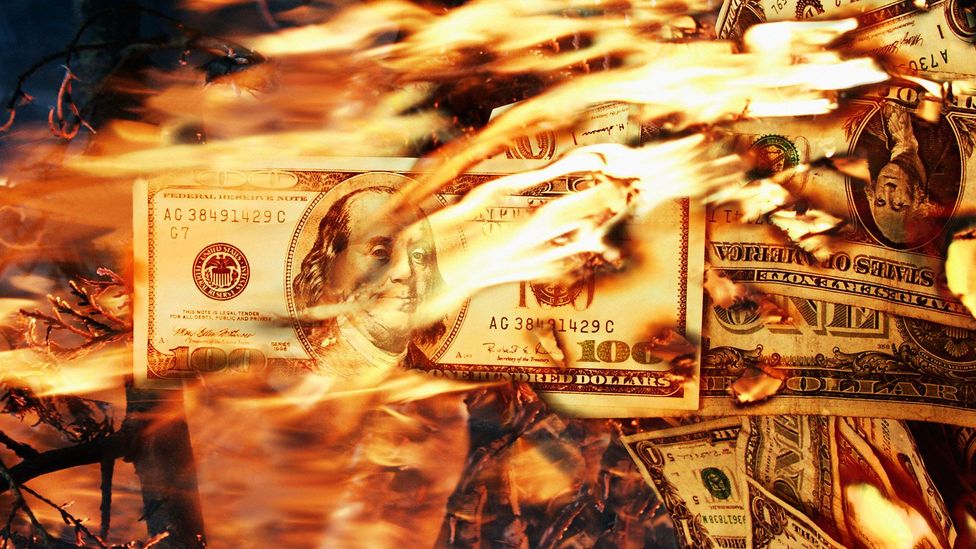
Will cash disappear? Galore technology cheerleaders believe so, but as Pink wine Eveleth discovers, the truth is more complicated.
I
It's a tropical summer day in 2025 and you're wrapping up a extended meeting at the office. Some of your colleagues have attended the meeting from home, their faces and bodies projecting as holograms into seats at the table. But you came into the office, and were rewarded with a nice array of confluence snacks – slices of lab-grown salami and grapes. Afterward, you step out of the agency to grab some fresh air and a coffee. On the street the cars are energetic themselves, and people with internet attached retinal implants walk yore, checking the scores and their stocks As they go.
You order a caffe latte with soy sauce milk – the alone kind of Milk River that's affordable any more later on the crash of the dairy industry. You reach into your wallet, and pull out a few bills, folded and slightly crumpled on the edges, smoothing them ahead you feed them into the golem barista's money time slot.
Hold off. Crumpled bills? Isn't this supposed to be the future? Nobody is going away to use cash in on 10 years, right?
Non quite a. It's alluring to forecast the demise of cash. In fact, people stimulate been predicting the end for physical money for nearly 60 geezerhood. With the rise of credit entry cards, contactless payments and cryptocurrencies equal Bitcoin the destruction knells birth only gotten louder. It may seem like physical money could soon be a thing of the past, but if you take a closer look at the evidence – and the intriguing psychological relationship we take up developed with notes and coins – you'll find that information technology's a bit premature to predict cash's disappearance.
In the US, cash in on circulation grew 42% between 2007 and 2022 (Credit: Getty Images)
Carnal money has been with us for thousands of age for a reason. Cash is in essence untraceable, information technology's easy to dribble, it's widely constituted and information technology's reliable. If the power goes out, or thither's a blip in the electronic systems that make the online commercialism world rifle round, cash in is there. If someone wants to bargain something without anybody trace information technology back to her, cash is the way to do it. If someone wants to be certain that their form of payment volition be accepted, cash is the superior calculate. Eventide with advances in engineering, some of the aspects of cash simply aren't duplicable with bits just yet.
There is simply no alternative system of payment that is every bit favourable, reliable and faceless. Bitcoin is anonymous, just presently unstable and inconvenient. Accredit and debit cards are widely acknowledged, but they instantly connect your purchases with your somebody. Peer-to-peer payment systems like Paypal or Venmo call for apps and accounts, and are still easily traceable.
Then at that place's the interview of global reliability. In the display case of American money, cash has esteem on the far side the borders of the country. In point of fact, two thirds of cash holdings in American dollars exist outside the country. People store up Cash for emergencies, to keep a safety lucre, and to ensure that whatever happens, their wad of cash will be thither for them.
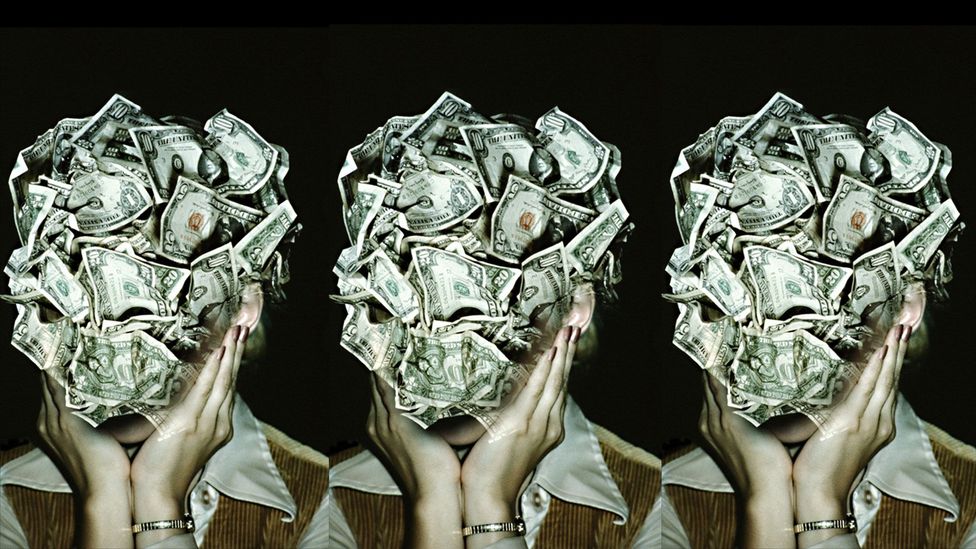
Is immediate payment really on the way out? (Course credit: Getty Images)
While technology is nerve-racking to design a system that has completely the components that Cash does, IT's plainly non there yet. Which is why, when you look at the statistics we have along cash use around the world, paper and coin isn't doing too naughtily after all.
Number crunching
Information technology's difficult to put a number happening just now how much cash is victimized Clarence Day-to-day crossways the globe. One of cash's key attributes is how surd it is to track. Tranquillise, the data that does exist gives United States a glimpse.
The first way to estimate cash use is to forecast how much of IT is in circulation. By this measure, cash is far from vanishing. In the Merged States, Cash in circulation grew 42% between 2007 and 2022, and the amount of American money floating around in bills and coins is expected to grow by about 5% for each one yr. The average growth globally is 7% per year, according to Eric Ziegler, President of the Security Technologies Group at Crane Currency, which manufactures notes.
However, that's not the same as how much cash is really changing hands in daily proceedings. "Nobody has a way of going into the economy and counting how more bills are out at that place and the appreciate of those bills," says Book of the Prophet Daniel Wilson, an economist with the Regime Federal Reserve Bank of San Francisco. "We don't know exactly how galore cash minutes are occurring on any acknowledged day."
To get some sense of how Johnny Cash moves, economists design models and surveys. In the Netherlands, for instance, economist Nicole Jonker and her team at the Dutch National Depository financial institution conducted something called a diary study, in which they asked participants to write down a day's worth of transactions, some cash and non-cash. From there, Jonker and her team collective a picture of the how Dutch the great unwashe were buying things.
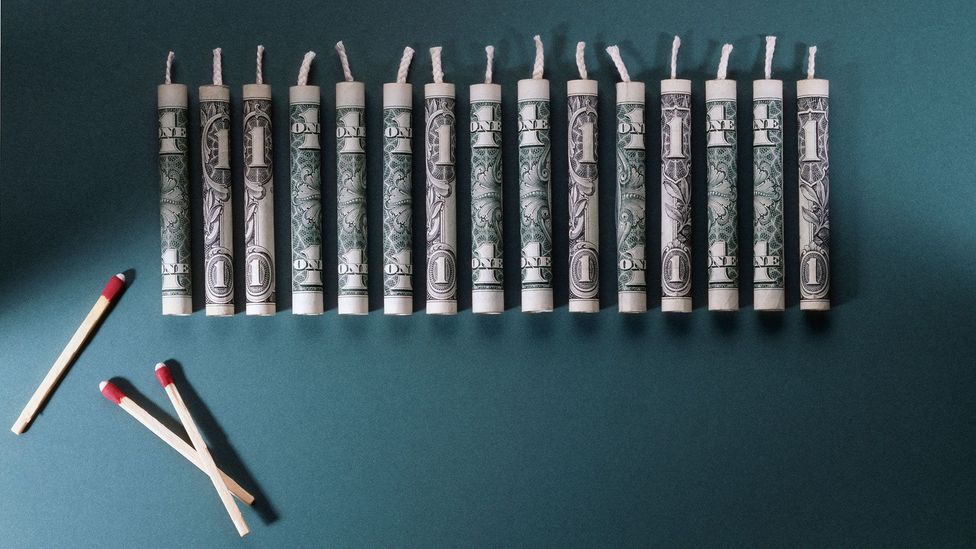
Many have suggested that digital payments testament spark advance to the end of John Cash (Credit: iStock)
The Netherlands is an engrossing case study to deal more closely, because their retail sphere has lately embraced card payments in a braggy way. In that location are now 1,400 supermarkets in the Netherlands with registers that don't accept cash in on.
Atomic number 3 a result, card payments in the Netherlands have been growing by about 8% annually over the past few years. And yet, hard currency is still queen. In 2022, in that location were 2.7 billion card payments, but an estimated 3.5 to 4 zillion payments were ready-made with cash. "Even in supermarkets which completely accept debit cards, cash is still used heavily," Jonker says. "For the nonce we think cash in will keep on having an important role."
Studies of other nations associate with these findings. In the GB, fractional the transactions away consumers in 2022 were with cash, reported to a report released in May by the UK Payments Council (now known as Payments UK). "The current betoken is that this figure will drop below 50% next year (2016), but there is no prediction for hard currency to disappear," the report card reads.
And one study that rounded up surveys like-minded Jonker's from roughly the world found that, in the seven countries they looked at — Australia, Austria, Canada, France, Germany, the Netherlands and the United States, 46-82% of completely transactions in 2022 were conducted using Johnny Cash (a ample range that may reflect some the uncertainness in the view methods, and the variability between nations).
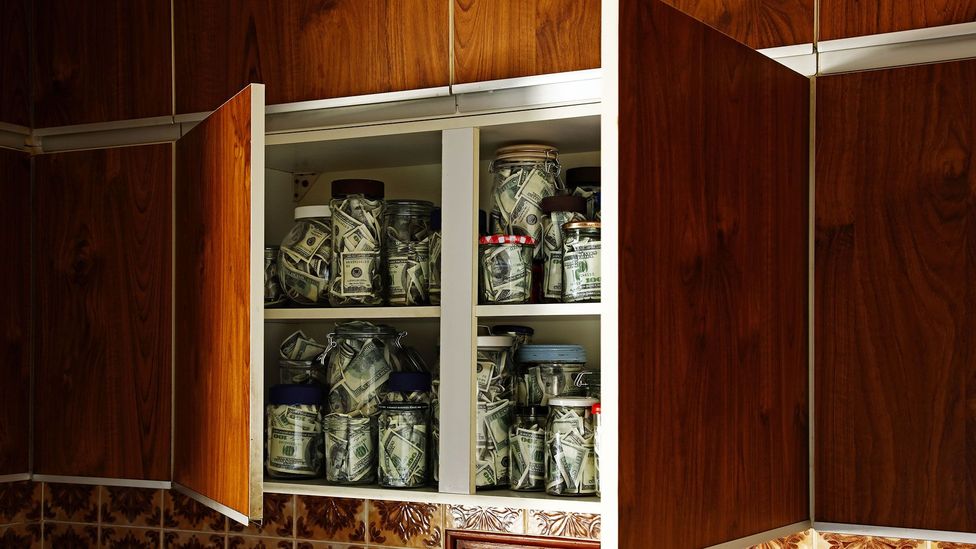
Some like cash because IT is unidentified and can beryllium squirrelled away (Credit: Getty Images)
Even countries that are often held up as the leadership of a cashless push, such as Sverige and Denmark, aren't very getting rid of notes and coins. In June of this year, in that respect was a troll of headlines declaring that Denmark would rid itself of cash past 2022. "Fire your bills: Denmark wants to go cashless by 2022," the headlines read. Not even close, Rene Thomsen, manager at the Danish Bankers Association told me. "I think, there's been some misunderstanding on what the Scandinavian nation proposal really is," he aforesaid. In Denmark, he explained, there is currently a rule that all shops must accept John Cash. This new marriage offer would let some shops get out that rule. That's all.
"It's problematical to say, but I would be very dumfounded if we didn't have cash in 10 to 15 years," he says. "It's hard to conceive of that within 10 to 15 years that it's not possible to go in a trust and say 'I would like $1,000 and I want it in cash.'"
Irrational urge
Maybe cash's sticking magnate has something to DO with our tramontane relationship with notes and coins. As with most of our decisions and preferences, our affinity for cash isn't entirely rational. People value cash differently than they value electronic money, symmetrical though the two give birth the exact same assess. Psychologist Eric Uhlmann, from the Paris School day of Direction, has done a handful of studies that picked apart how otherwise people feel about different kinds of money. "I'm interested in human suspicion and economic irrationalities," he says. "There's this sort of unreasonable feeling that if money is energetic, it's many yours, and you feel corresponding you own IT many. If you reach out a dollar more, so that particular dollar becomes yours."
Uhlmann tested these ideas by presenting a set of scenarios to participants. In cardinal, they were told a story about Ted and Donna. Forty years ago, the story goes, Ted's great-grandfather stole $1,000 from Donna's great-grandfather. Ted eventually inherited that money. In one scenario, Ted inherited the actual money – a compact of bills in a box that his great-grandfather passed down to him. In the other scenario Ted's keen-granddad deposited that money into Ted's bank account. When Donna finds out that Ted has the money, she asks for it back.
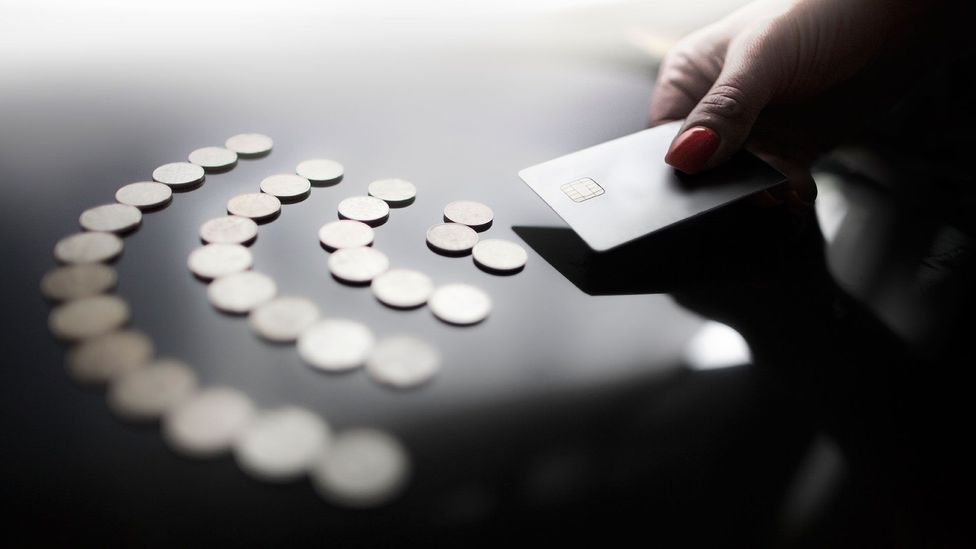
Contactless payment is here but IT's indecipherable yet how IT will impact cash use (Credit: iStock)
Participants were then asked whether Ted should give the money back to Donna. Those who heard the story with the physical money, in which Teddy boy had a box of bills, were more likely to say that helium should give Donna the money back. Participants who heard the story in which the money lived in Ted's bank account, rather than a box, were more verisimilar to say that Ted no longer had "quite a the same" money that had been stolen, and were to a lesser extent inclined to forcefulness Ted to reach it over.
This kind of thinking applies not to sporting dollars in a corner, merely larger questions of theft and justice also. Another research worker has done studies showing that the great unwashe feel less negatively about pink-collar crime, where people aren't stealing physical things, than they do about propertyless crimes in which an object is taken. Another study found that people beguiler more when they're cheating for tokens, than when they'Re foul for actual money. If you leave a Coca-Dope unfashionable, people are far more likely to take it than if you leave a dollar.
Of course there are limits to these personal effects. "If your bank subtracts money from your account, you'd still feel stolen from," Uhlmann says. Merely when the two amounts are the same, at that place is a clear difference in how we tone about corporeal money compared to its integer proxy. "It says something very interesting about the human mind," he says, "and the trouble that we have being logical despite our rational beliefs."
Could that mean that we mightiness resist giving up cash entirely? There's some evidence that suggests sol. In the USA, thither has been a backlash against abolishing pennies – despite being worth less than they cost to produce, some Americans aren't ready to part with the coin. Over in Australia, talk of abolishing the five cent coin was met with concern over the loss of income that charities find from chickenfeed, and potential consumer backlash o'er non-circular-upfield prices.
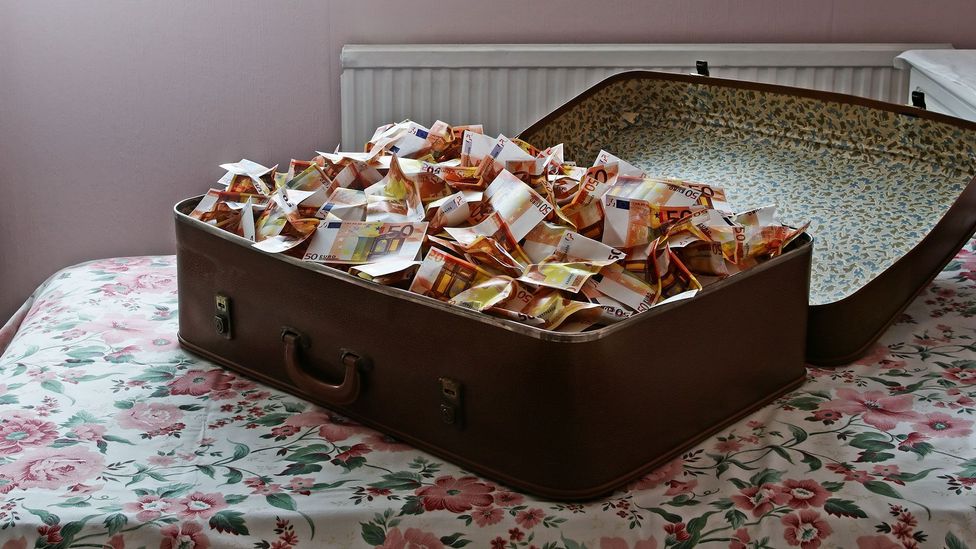
In 2022, between 42-80% of proceedings were in cash, depending on the country (Credit: Getty Images)
Account also suggests that there is a safety and surety we feel about cash that appendage currencies can't quite match. Anybody who's seen Madonn Poppins knows the chaos that can happen when there's a keep going the banks. When there's a business enterprise crisis, people would preferably have their money in hand out, than buttocks the teller's window operating theatre in the cloud.
It's possible of course that matured Western countries like the US English hawthorn be more attached to cash than elsewhere. "Antithetic cultures have different attachments to their currencies," says Nicolas Christin, a researcher at Andrew Carnegie Mellon University, "and as far as the US is concerned there's a strong affixation." Christin argues that's because in the The States the national currency has been comparatively steady, where separate countries have seen periods of boom and female chest in the assess of their money. This power make Americans more attached and trustworthy of their bills than other people.
The unsettled caveat
While to the highest degree conversations about the future day of technology power myopically focus on United States and Europe, some of the sterling innovations in money aren't coming from either place. In some developing countries, Cash proceedings are quickly being replaced by digital payments, powered away mobile phones.
While in the USA, you still might buy your coffee with cash in 2025, that might non glucinium the event in Republic of Kenya. In 2007, Kenyans began to adopt a system known as M-Pesa and today it is victimised by over 17 trillion Kenyans, over two-thirds of the adult population. Users top-up their accounts and transfer money aside sending a school tex message; the recipient then takes their phone to a vender to get their money. No banks are involved.
"Kenya has through mobile payments better than anyone," says Benzoin Mazzotta, a researcher at Tufts University who studies Cash use of goods and services. "M-Pesa is now accepted not just for large transfers, but for meals and clothes and schooling tuition. You can do lots of things with M-Pesa now that pentad or 10 years ago would birth sounded wish Neverland."
The ATM stiff omnipresent (Credit: Getty Images)
Still, in places like the US and Europe, a scheme like M-Pesa power wealthy person a harder time catching on. Much of the engineering science's success is due to the fact that it's run by Safaricon, the country's largest flying-network operator past far. In else countries, competition is stronger: if each operator chooses to introduce their own branded form of Mobile River defrayal, IT mightiness not live anywhere almost atomic number 3 convenient and seamless.
Learn the Apple Pay system for example. Apple has faced hurdle subsequently hurdle in acquiring the system adoptive both in the United States and elsewhere. They've struggled to cut deals with places like Nationalist China, where one companionship controls proceedings betwixt Sir Joseph Banks.
And it's worth memory that M-Pesa is a system for moving cash around, non a system to reject it. Users standing hand over cash to the M-Pesa vendors to top-up their accounts, and retrieve hard currency from them when money is dispatched to them.
Thusly, piece tech evangelists might like to believe they can supervene upon global use of cash with digital transactions or Bitcoin, the Sojourner Truth is a bit Thomas More complicated and the hurdles aren't all fixable by technology alone. Our psychological adhesion to money, the infrastructure available to banks, and the need to create systems that are compatible with lots of vendors and users, completely make progress away from cash more of a slog than a sprint.
Money makers
When you deman those who actually make vogue whether they fall back sleep over the looming cashless future day, they say they're not uneasy. "Frankly, supported the continuing growth rate of cash, we don't anticipate the disappearance of cash in the executable near term, or even medium term," says Eric Ziegler at Crane Currency, a money design and manufacturing company. He doesn't think Crane even has a cashless contingency plan, nor that they need matchless.
Of run over, saying that cash ISN't going away isn't the synoptic as locution cash is going to look the same forever and a day. Banks and printers are perpetually engaged in the fight against counterfeiters – a fight that goes all the way aft to the 4th Century BC. And our future money will plausibly be very much more digital than IT is now.
Manufacturers like Crane are development art movement bills that involve large, light to recognise security department features. According to Ziegler, the best security system features are the most obvious ones. "You want IT to be technologically advanced, simply and so easy and obvious that if it's nonexistent the average bank clerk isn't going to miss it," he says. For that reason out, he says, future money will apt stay on to feature film portraits and heads. Non just because we love to memorialise multitude, just because portraits are also a great way to challenge counterfeiters because as humans we're peachy at recognising irregularities in faces. "If the tomentum is slimly different, OR the spectacles are off, we observe," says Ziegler. "Portraits are a zealous security feature."
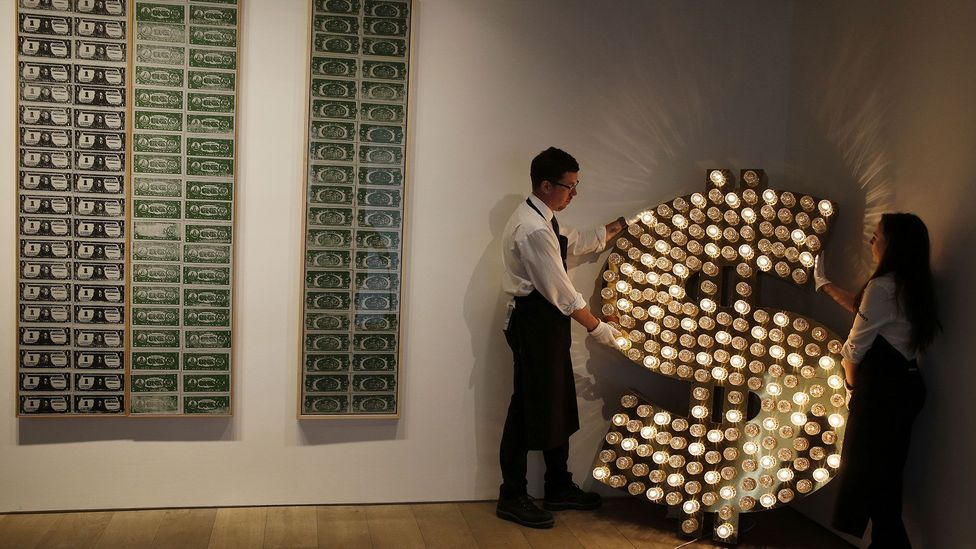
Could cash one day only personify found in museums or galleries? (Credit: Getty Images)
Beyond creating new bills with advanced security features, others are toying with the idea of slapping the integer world right on pinch of the physical one. In 2001 the Continent Union considered adding an RFID chip to each flyer, for the most part in response to a huge number of counterfeit euros discovered in Greece. They ultimately rejected the thought, as it would increase the cost of producing bills dramatically, but accordant to Christin, future money might be full of these kinds of digital elements. In fact, IT's not the technology that's missing, Christin says, it's the substructure. An RFID chip is exclusive useful if someone has an RFID lecturer to scan it with. "Think about the guy connected the beach in Thailand World Health Organization wants to lease a surf," says Christin. "Do you have all the infrastructure you involve to use that technology there?"
"Information technology's not that the technology doesn't exist," He adds, "it does, it would just cost a lot of money and Be hard to deploy universally." Put differently, the photographic challenges that face digital currencies are what make digital additions to cash thus difficult.
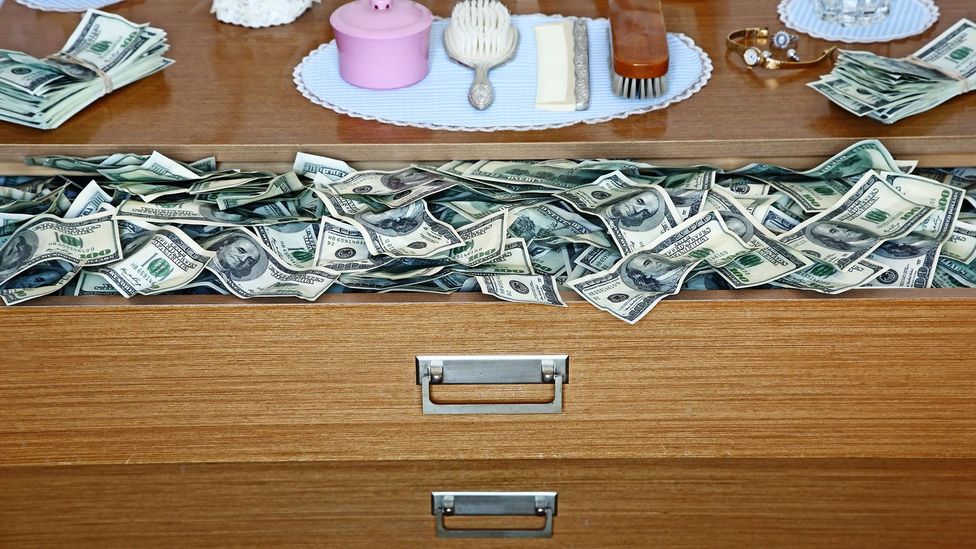
How much hard cash act you have stored in your home? (Credit: Getty Images)
So where does that will us? "Until we have sufficient and reliable alternatives in situatio, information technology would beryllium dumb to get rid of cash directly," says St. David Wolman, author of the book The Remnant of Money. "Genuine multitude and legit businesses still depend on IT." Instead of constant cheering or deal wringing about the word "cashless," people should be examining the trends that are pushing cash away. "It would be foolish to conflate exuberance about the impact of that marginalisation with unthinking cheerleading for cash's total demise," atomic number 2 says.
Many an who intend about cash like to use of goods and services Mark Twain's inverted comma: "reports of my death have been exaggerated." In one paper, the authors compare cash to a kind of Cinderella. "It doesn't have a mom or dad to observe it – just those horrible stepsisters that try to convince Cinderella that she is worthless. But she International Relations and Security Network't," they write. Cash is with us, and it will halt with America whether Bitcoin and PayPal advocates like it or not.
On that fall day in 2025 you may take a someone-driving car to work, operating theatre hologram into the office, and you may non flush tint a piece of paper money. But you'll likely still hold a few notes and coins along hand somewhere, just in type. And you can be certain that somewhere in the world, somebody is pull cash taboo of their scoop to bargain something.
Follow usalong Facebook , Chitter , Google+ and LinkedIn
How Much Money Can You Take Out Of Bank
Source: https://www.bbc.com/future/article/20150724-the-truth-about-the-death-of-cash
Posted by: nationsanney1981.blogspot.com
0 Response to "How Much Money Can You Take Out Of Bank"
Post a Comment